
history · 7 min
The Trees That Build the Coast
How red, black, and white mangroves made Florida's shoreline, and why the state nearly cut them all down.
By The Editors ·
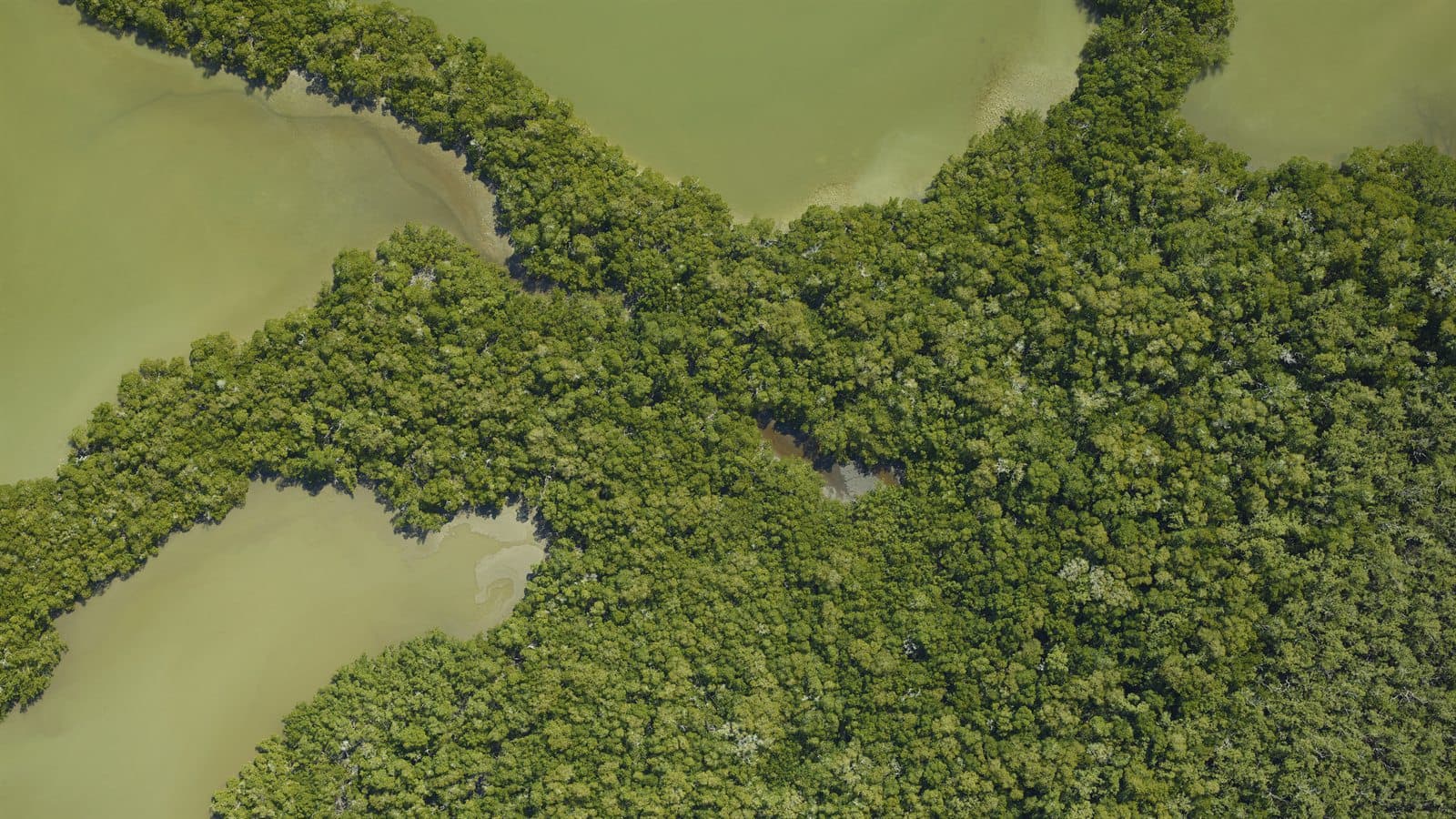
Where the land gives out in South Florida, the trees keep going. Red mangroves wade out past the shoreline on arching roots, standing in salt water that would kill almost anything else, and behind them the coast holds together largely because they are there. For a long time Floridians looked at that tangle and saw wasteland. It is closer to the opposite. The mangrove is one of the few plants on earth that builds new land, and along the bottom third of the state it has been quietly building Florida for thousands of years.
Three kinds grow here, and they sort themselves out by how much salt water they can stand. Closest to the sea is the red mangrove, the one most people picture, propped up on a thicket of reddish roots that arch down from the trunk and branches like so many bent legs. Those prop roots do two jobs at once. They brace the tree against tide and wind in soft mud that offers nothing to grip, and they carry air down to the roots buried in muck that holds no oxygen at all.
Salt, and How to Live in It
Salt is the problem every mangrove has solved, each in its own way. The red mangrove keeps most of the salt out at the root, filtering seawater before it ever rises into the tree. The black mangrove, which grows just inland of the red on slightly higher ground, takes the salt up and then pushes it back out through its leaves, so a black mangrove leaf often wears a fine dust of salt crystals you can taste off the surface. The black mangrove also sends up its breathing roots from below, hundreds of pencil thick pegs called pneumatophores standing straight out of the mud around the trunk, pulling in the air the flooded soil cannot give. Farthest from the water, on the highest and driest ground the tide still reaches, stands the white mangrove, with no showy roots at all. Walk inland from open water and you cross the three in order, a banding so reliable that botanists read the elevation of a shoreline by which mangrove is growing on it.
They reproduce in a way that fits a life spent in moving water. Instead of dropping a seed and hoping, a mangrove lets the seed germinate while it still hangs on the branch. The red mangrove's propagule grows into a long green spike, pencil shaped and heavy at one end, and when it finally drops it can either plant itself point down in the mud below or float off on the tide, riding the current for weeks or months until it fetches up on some far bank and takes root. A good deal of Florida's coast was colonized one floating seedling at a time.
What the Tangle Does
Underneath, the same roots that hold up the tree make a nursery. The flooded thicket is a maze that small fish can hide in and big ones mostly cannot reach, and a long list of the species Florida cares about, snook and tarpon and snapper, along with shrimp and crab, spend their early lives sheltering there before they ever move out to the flats and reefs. The fishing economy that runs on those adult fish is worth hundreds of millions of dollars a year, and much of it begins in the mangrove roots. Above the water the canopy does the same work for birds, holding the rookeries where roseate spoonbills, pelicans, herons, and egrets nest in numbers the open coast could never support.
The trees also stand between the coast and the worst of the weather. A band of mangrove only a hundred meters wide can knock the height of an incoming wave down by as much as two thirds, and a healthy forest can pull a storm surge down by close to a foot across a few miles of shoreline, which on this coast is the difference between a flooded street and a flooded house. While they do it, they bury carbon. Mangroves pack carbon into their waterlogged soil and hold it there for centuries and longer, far more per acre than a forest on dry land, the stored blue carbon that has lately made these swamps valuable even to people who never fish them. And the whole time they trap sediment in their roots and slowly raise the ground, the land building that gives the system its strange power to make coastline rather than just sit on it.
A band of mangrove a hundred meters wide can cut an incoming wave down by two thirds.
From Wasteland to Law
None of this counted for much with the people who developed Florida. The mangrove coast had been lived in for a very long time. The Calusa, who ruled the southwest shore for centuries, built whole towns on mounds of oyster and conch shell among the Ten Thousand Islands, working the same rich water the trees protect. But to the developers who arrived with dredges in the twentieth century, a mangrove swamp was simply land that had not been made yet. Beginning in the 1940s, and hardest through the postwar boom, crews cut channels and pumped the spoil up over the mangroves to manufacture dry, sellable waterfront. Whole shorelines went under fill. Around Lake Worth, by one count, close to nine tenths of the mangroves disappeared within a few decades, and the story repeated in one bay after another.
The reversal came slowly, as the fish and the water quality went out with the trees and the cost of losing them grew plain. Florida finally wrote the mangrove into law with the Mangrove Trimming and Preservation Act of 1996, which limits how much a landowner may cut, bans the chemicals once used to kill the trees back for a better view, and treats a stand of mangroves as something closer to public infrastructure than private nuisance. It did not undo the dredge and fill years. It did slow the bleeding, and it put the burden on the person who wants the mangrove gone rather than the one who wants it kept.
The Coast on the Move
Now the trees are moving again, and this time the climate is doing the work. Florida sits near the cold edge of where mangroves can grow, and what has always held them back is the hard winter freeze that kills the seedlings. As those freezes come less often, the mangroves are marching north up both coasts, settling ground that used to be salt marsh and, by some projections, reaching the Carolinas before the century is out. It is not a simple gain. A mangrove forest moving in is a salt marsh going out, two valuable systems trading places, and along the most developed shorelines the trees are caught between rising water in front of them and seawalls and subdivisions behind, with nowhere left to go. Coastal scientists call it the squeeze.
Stand in a red mangrove at a falling tide, with the water draining out through the roots and a heron working the shallows it left behind, and it is hard to picture the half century the state spent trying to erase exactly this. The mangrove keeps no record of that. It just keeps doing the work, holding the edge of Florida in place and, where we let it, quietly adding to it.