
history · 7 min
How Tarpon Springs Became the Sponge Capital
A Philadelphia businessman, a sponge buyer from Leonidio and 500 Greek divers turned a river town into the largest sponge port in America, until the beds died.
By The Editors ·
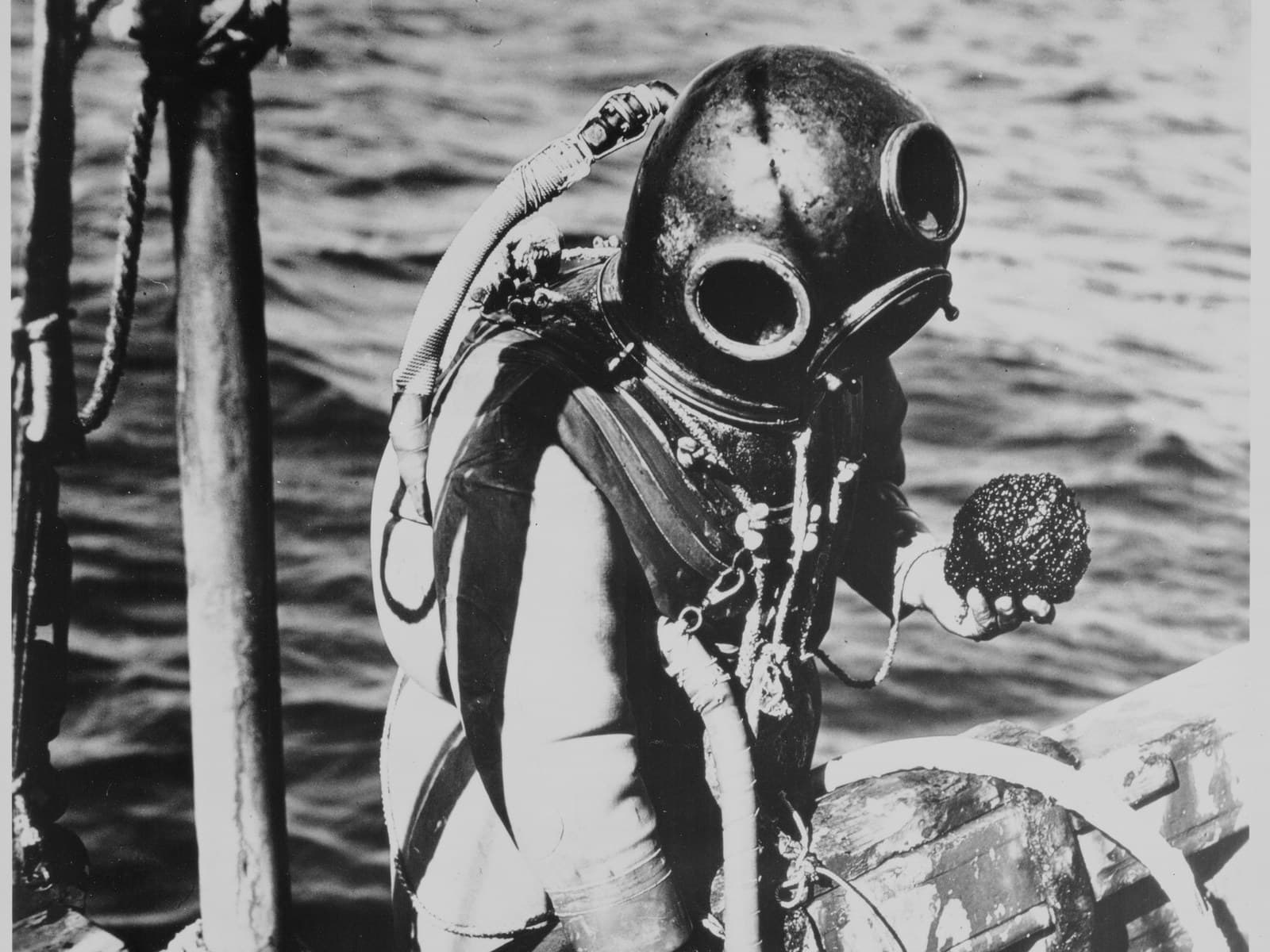
On June 18, 1905, a man in a rubberized canvas suit and a copper helmet went over the side of a sailboat off the Anclote Keys and walked on the bottom of the Gulf of Mexico. Two men on deck cranked the pump that fed his air. The boat was the Elpis, Greek for hope, bought and refitted by a sponge buyer named John Cocoris and his brothers. The city's own history of its Greek community says the diver came up and reported enough sponges down there to supply the whole world. That line rests on a single telling. The rest of the year does not. By December about 500 Greek men had arrived in Tarpon Springs.
Hook Boats
Florida had been in the sponge trade for half a century, and the trade belonged to Key West. The first shipment went to New York in 1849 and sold against the Mediterranean sponge. Spongers worked from dinghies, two men to a boat, one at the oars and one leaning over the side with a glass-bottomed bucket and a long pole with a three-pronged hook. They could reach two to five fathoms. By 1890 Key West had about 350 hook boats, and the federal count that year put Florida's catch at some 367,000 pounds, worth $438,682. In 1897 sponges were a third of the value of everything the state's fisheries landed.
The beds off Tarpon Springs were found by accident in 1873, when Key West turtle fishermen fouled their nets on sponges off the mouth of the Anclote River. The catch still went south to be sold. The man who changed that was John K. Cheyney, a Philadelphian who had followed Hamilton Disston to Tarpon Springs. He went to Key West in 1889 to learn the business, came home and opened the Anclote and Rock Island Sponge Company in 1890, and paid for the town's first hook boat. In 1898 Spanish warships off the Keys sent the Key West fleet north to land its catch on the Anclote, and by the early 1900s Tarpon Springs was the largest sponge port in the country.
Cocoris had arrived in 1896 as a buyer for the Lembessi company of New York and gone to work for Cheyney the next year. From Leonidio, in the Peloponnese, he knew the Greek islands had been diving for sponges in hard-hat gear since the 1860s. Cheyney put up the money. The first crews came from Aegina and Hydra. The men who followed, by letter and by advertisement according to the city's account, came from the Dodecanese, from Kalymnos and Symi and Halki, and soon outnumbered them. By 1920 more than 1,500 Greeks lived in town and more than 200 boats worked out of the river.
The suit opened beds twenty fathoms down that no hooker could touch, and it carried a cost the islands already knew. In 1867 a French navy physician reported from Kalymnos that of 24 divers using twelve suits that season, ten had died. The cause was the bends, gas coming out of the blood when a man rose too fast. In 1930 a Tarpon Springs sponge man named E. P. Macrenaris told the Rotary Club that the old free divers had never suffered "partial paralysis or bends as is unhappily too often the case today."
The Exchange
Sponge buyers organized the Tarpon Springs Sponge Exchange in 1907 and incorporated it in 1908, a one-story building around three sides of a courtyard with cell-like rooms behind open-work iron doors, one to a boat. Auctions ran twice a week, and they were silent. The buyers looked over the catch and handed written bids to the manager, who read out only the highest name and price. A crew could refuse a bid once and try again the next day. Almost none refused twice, since nobody could outfit for the next trip until the last one was paid for.
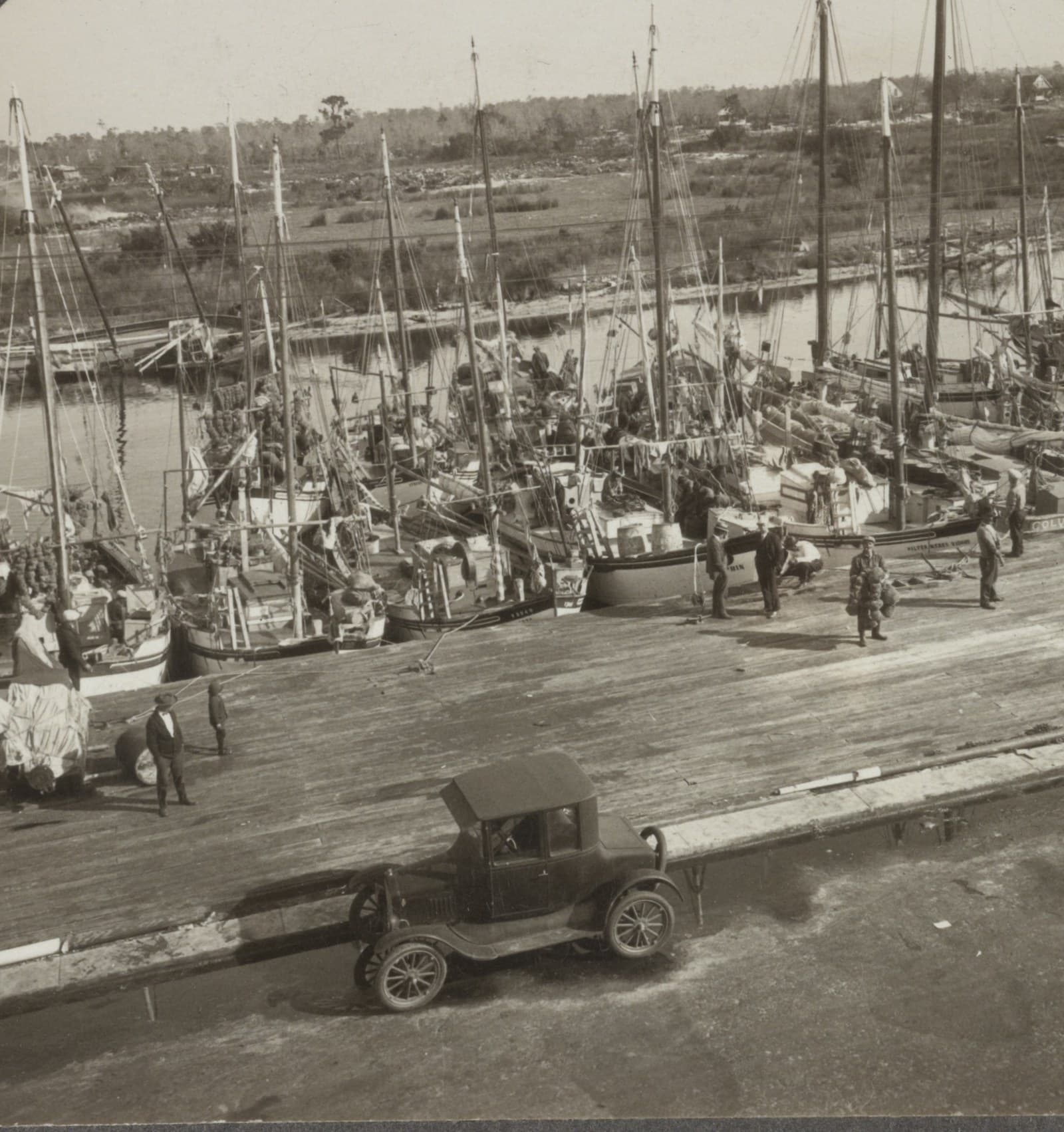
It paid. A 1924 federal tally shows the trade moving north: in 1902 Key West landed 77 percent of Florida's sponges and Tarpon Springs 19; by 1918 Tarpon Springs landed 76 percent. Diving boats alone sold $886,381 through the Exchange in 1927. The state's catch peaked in 1936 and 1937 at about 714,000 pounds, worth a little more than 1.2 million dollars. The sponge families set aside a share of each catch for the church. St. Nicholas was a frame building in 1907. The cathedral that replaced it, with white marble from Mount Penteli, opened in 1943.
In 1943 the sponges sold at Tarpon Springs averaged 13 dollars a pound. Before the war the whole Florida catch had brought under two.
Blight, War and Red Water
The disease came first. In the winter of 1938 something began killing the commercial sponges of the Bahamas, 60 to 90 percent of the adult wool and velvet sponges, and by the spring of 1939 it had spread through the West Indies to the northwest coast of Florida. Paul Galtsoff of the Fish and Wildlife Service traced it to a fungus. Then the war shut the Greek sponge out of the American market, and prices climbed. Before the blight the Florida catch had averaged well under two dollars a pound. In 1943 the sponges sold at Tarpon Springs averaged 13 dollars a pound, and the state's fishery records say the best wool sponge touched 30. In 1944 the Exchange sold 37,531 bunches, the smallest count on record, for $2,551,863, the most money in its history; before the war it had handled 200,000 bunches a year. More boats went out and undersized sponges came up. The value peaked in 1946, at three to four million dollars depending on who was counting.
The red tide began off Naples in November 1946, killed fish up the coast to Sarasota by January, and came back larger in the summer of 1947. About August 8 the sponge fishermen at Tarpon Springs saw red water off the harbor. Half a billion fish died, and the town has said ever since that the red tide killed the sponges. The scientists did not find that. Galtsoff questioned the captains and divers and reported "no evidence of any damage to sponge grounds by red water," and the Service's own leaflet noted that the principal beds lay outside the affected area. A mortality ran through the west coast beds in 1947 and 1948 that the University of Miami's laboratory could not explain, and in October 1949 the Service announced a new disease that had ended sponging from Tarpon Springs to St. Marks. The Greek sponge was back on the market, and DuPont had a cellulose sponge in the stores. By 1951, by one state count, the Florida catch was about 13,000 pounds worth $80,000, under three percent of the peak. Families went north to the steel mills of Indiana and Ohio, by the city's account.
What Is Left
In 1986 a disease hit the Mediterranean beds, and the orders came back to Florida. The sponges had returned, and divers cut them at the base instead of tearing them loose, which is now a state rule. Florida lands 60,000 to 70,000 pounds a year, a tenth of the 1930s. A 2022 count put six commercial sponge boats working out of Tarpon Springs. Tourism is the first industry now. The St. Nicholas Boat Line, in business since 1924, puts a diver over the side in the old suit, the Exchange is shops, and five of the old boats are on the National Register.
Every January 6 the archbishop casts a cross into Spring Bayou and boys of 16 to 18 go in after it. Tarpon Springs first kept Epiphany in 1903, the Greek Orthodox church took it over in 1906, and the dive dates from 1920. About 20,000 people come. Before the cross goes in, the clergy bless the sponge boats and the divers and remember the men the bends took. More than one resident in ten is of Greek descent, a larger share than in any other American city.
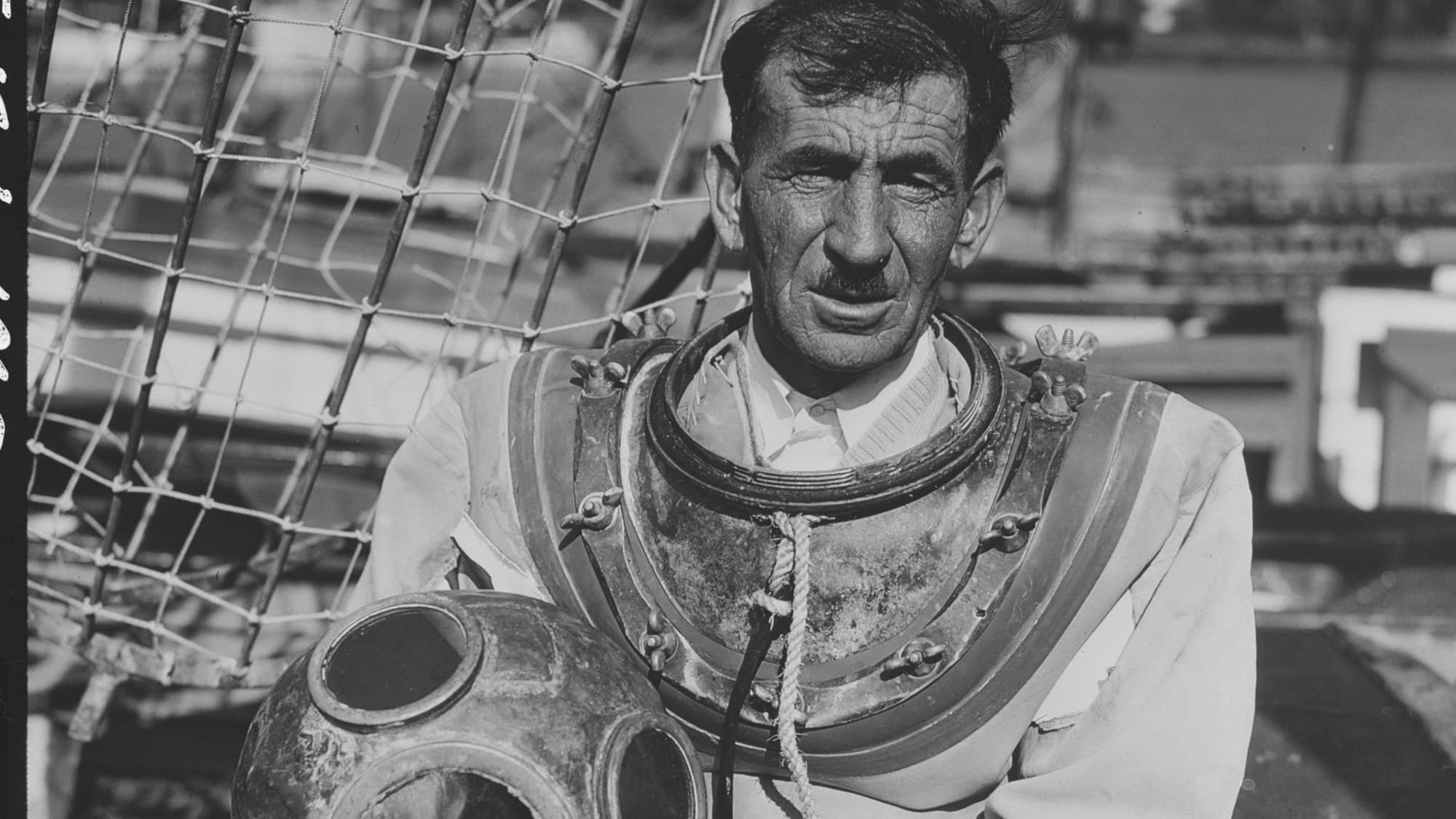
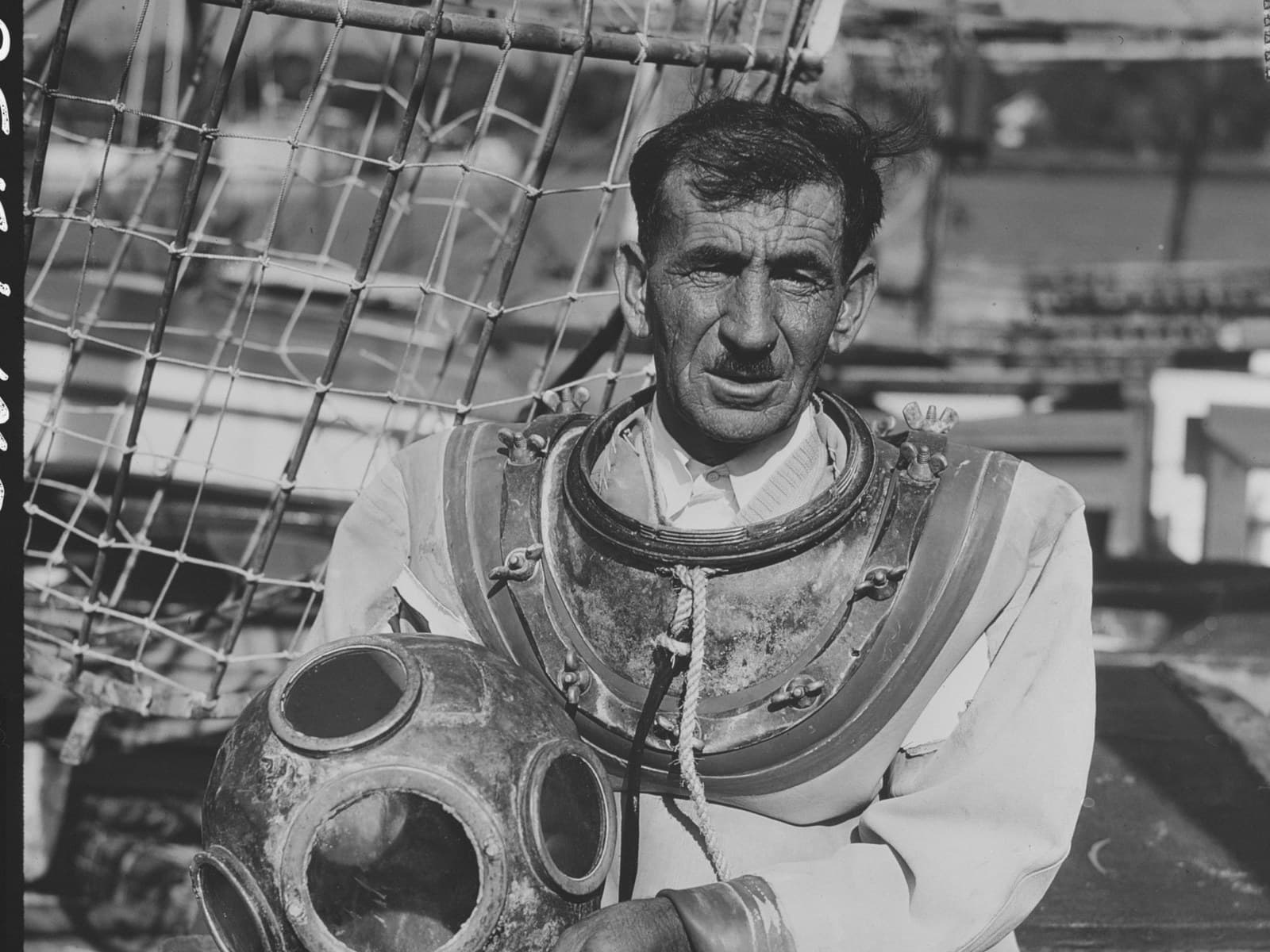
In January 1944 a photographer for the Office of War Information came to the docks and made thirteen pictures on Kodachrome, the fleet, the divers, the sponges strung on wire. One shows a diver on deck holding his helmet in front of him, the way a man holds his hat. They caught the sponge capital in a record year, three seasons before the beds died.
Questions people ask
- When did Greek sponge divers come to Tarpon Springs?
- The first diving crew went down on June 18, 1905, off the Anclote Keys. John Cocoris, a sponge buyer from Leonidio who had worked for the Tarpon Springs sponge merchant John K. Cheyney since 1897, brought the boat, the gear and the first men from Aegina, and about 500 Greeks had arrived by the end of 1905. The ones who followed came mostly from the Dodecanese islands of Kalymnos, Symi and Halki, where hard-hat sponge diving had been practiced since the 1860s. By 1920 more than 1,500 Greeks lived in Tarpon Springs and more than 200 boats worked out of the Anclote River.
- Did the 1947 red tide kill the Tarpon Springs sponge beds?
- Not according to the scientists who studied it. The red tide of 1946 and 1947 killed an estimated half billion fish along the Gulf coast, and sponge fishermen at Tarpon Springs saw the red water off their harbor about August 8, 1947. But Paul Galtsoff of the Fish and Wildlife Service questioned the captains and divers and found no evidence of damage to the sponge grounds, and the Service noted that the principal beds lay outside the affected area. The sponges did die, from a mortality in 1947 and 1948 that the University of Miami's laboratory could not explain, and a second disease in late 1948. By 1951 the Florida catch was under three percent of its peak.
- Is there still a sponge industry in Tarpon Springs?
- A small one. The beds slowly recovered, and when a disease hit the Mediterranean sponge in 1986 the orders came back to Florida. Divers now cut sponges at the base instead of tearing them loose, which lets them grow back, and the state requires it. Florida lands 60,000 to 70,000 pounds a year, about a tenth of the 1930s catch, and a 2022 count found six commercial sponge boats working out of Tarpon Springs. Tourism is the main business on the docks now. The St. Nicholas Boat Line has run demonstration dives since 1924, the Sponge Exchange is shops, and the Epiphany dive on January 6 draws about 20,000 people.