
history · 7 min
The Last Can of Concentrate
Florida invented frozen orange juice in a Winter Haven lab in 1945. This spring the company that made it famous stopped making it, and the groves behind it are nearly gone.
By The Editors ·
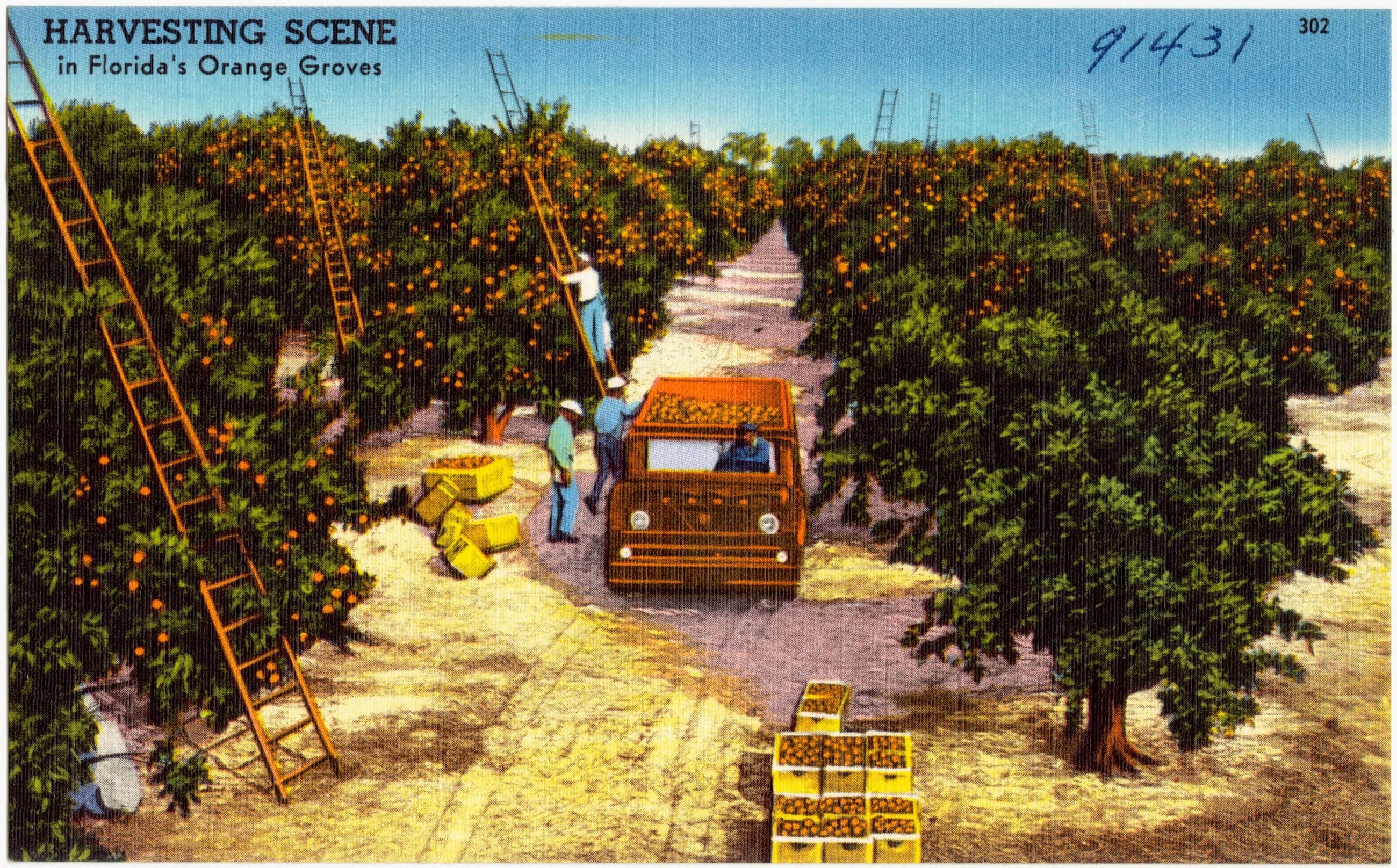
In February 2026 Coca-Cola told the trade it was ending Minute Maid's frozen juice concentrates, every flavor, with production to stop by April. There was no press event. A product that had sat in American freezers for eighty years went out with a supply notice. By then a twelve ounce can that cost about $2.32 in January 2020 was running near $4.86, when a store had it at all, and most shoppers had long since moved to the carton in the refrigerator case.
The can was a Florida invention, and for half a century it was the reason Florida planted oranges the way it did. Its ending is a fair place to take stock of what the industry has become, because the numbers behind it now read like a different state.
Winter Haven, 1945
During the Second World War the Army quartermaster wanted orange juice that could be shipped to troops without spoiling, and in 1942 put out a contract for anyone who could make a frozen version that tasted like something. Concentrating juice was not the hard part. Boiling off the water also boiled off the flavor, and what came back when you added the water was flat and cooked. The problem went to a United States Department of Agriculture laboratory in Winter Haven, in the middle of the citrus belt, where three researchers, Louis MacDowell, Edwin Moore, and Cedric Atkins, worked it out.
Their answer was the cut-back. Evaporate the juice at low temperature until it was far more concentrated than needed, then stir a measure of fresh, untouched juice and a little peel oil back into it. The fresh juice carried the volatile aromas the evaporator had driven off, and the result, frozen and later mixed with three cans of water, tasted close enough to the real thing that people bought it by the case. The first commercial run came out of the 1945 to 1946 harvest, roughly 225,000 gallons. The patent, number 2,453,109, was granted in 1948 and handed to the federal government, since the work had been done on the public's dime.
A Florida company called Vacuum Foods started selling the product in 1946 under the name Minute Maid. Bing Crosby bought in and sang for it on the radio. Sales were a little over $374,000 the first year. By 1955 they were close to $110 million. Frozen concentrate turned orange juice from a breakfast luxury into a staple, and it turned the Florida grove into an industrial supplier. Fruit that once had to be handsome enough to sell whole could now be anything, as long as it was sweet and there was a great deal of it.
The Belt Moves South
Oranges came to Florida with the Spanish, and were growing around St. Augustine within a generation of the town's founding in 1565. For three centuries the groves sat in the north of the peninsula, along the St. Johns and around the old settlements, close to the rail lines that carried fruit north after the Civil War. Then came the winter of 1894 and 1895. A freeze in late December killed the fruit, a warm January coaxed the trees into tender new growth, and a second freeze in early February killed the trees. Groves that had taken twenty years to bring into bearing were dead in a night. Whole towns emptied. The growers who stayed in the business replanted well to the south, down the sandy ridge through Polk and Highlands counties and toward the lake.
It happened again in the 1980s, in December 1983, January 1985, and December 1989, hard freezes that reached into Orange and Lake counties and finished off much of what was left there. The land those groves stood on was near Orlando, and it did not go back to trees. It went to subdivisions. The industry consolidated further south and got bigger where it went. By the 1997 to 1998 season Florida picked 244 million boxes of oranges, the most it ever had, from something close to 830,000 acres of citrus. Nearly all of it went to juice.
In 1997 Florida picked 244 million boxes of oranges. This year it picked 12.9 million.
Greening
In August 2005 inspectors found a diseased tree in south Miami-Dade County, the first confirmed case in the country of huanglongbing, which growers call greening. It is a bacterial infection carried tree to tree by a small insect, the Asian citrus psyllid, and it plugs the vessels the tree uses to move sugar. Leaves mottle. Fruit stays small and lopsided, stays green at the stem end, and turns bitter, and much of it drops before it can be picked. There is no cure. Once a tree has it, the tree declines over a few years and dies, and the state's own plant health office says so in plain words.
The psyllid moved faster than anyone could quarantine, and within a decade the disease was in every commercial grove in the state. Growers fought it with what they had, spraying for the insect, feeding the trees, pulling and replanting, and every year the count fell. Florida had nearly 28.7 million bearing Valencia trees in the 2021 to 2022 season. By this season it had about 14 million. The early and midseason oranges fell from 17.2 million bearing trees to 6.7 million over the same four years.
The weather did not help. Hurricane Ian crossed the heart of the belt in September 2022 and knocked fruit off trees already weakened by disease; the University of Florida put the citrus losses between $416 million and $675 million. Two years later Hurricane Milton came ashore south of Tampa Bay and ran east through Polk, Hardee, and Highlands counties, the three that still grow most of the state's oranges. The federal forecast that followed dropped by three million boxes.
What Is Left
The Department of Agriculture issued its final estimate for the 2025 to 2026 season on July 10, 2026: 12.92 million boxes of oranges, 4.77 million early and midseason and 8.15 million Valencia. It was up six percent from the April number and up from 12.28 million the season before, which the forecasters called progress, and it was. It was also the smallest orange crop the state has grown in nearly a century.
The acreage tells the rest. On August 27, 2026, the annual inventory counted 165,359 acres of commercial citrus in Florida, down 21 percent in a single year, a net loss of 42,827 acres. Every one of the 23 counties in the report lost ground. Polk County lost the most, 10,944 acres, and still leads the state with 37,529, with Highlands behind it at 34,671. Growers planted 5,200 new acres, fewer than the year before. Orange trees now stand on 143,650 acres, about a sixth of what they covered when the last cans of concentrate were selling well.
The growers who remain have real tools for the first time in years. A trunk injection of the antibiotic oxytetracycline, cleared for commercial use in Florida in 2022, has been holding sick trees productive, with yield gains of 30 percent or better reported after a single treatment. Breeders at the University of Florida are releasing rootstocks and varieties that tolerate the disease, and some young groves are being raised under mesh covers that keep the psyllid off until the trees are big enough to stand a chance. None of it is a cure. All of it costs money, in a business where the crop pays less than it did.
So the other tool is a for sale sign. Since 2019 the price of Florida farmland has roughly quintupled, and a grove with development potential, which describes most of the ridge between Orlando and Sebring, has gone up something like tenfold. A grower with dying trees, a hurricane deductible, and a developer's offer does the arithmetic the same way the Orange County growers did after 1989. That is how 42,827 acres leave the inventory in a year.
There is still a citrus belt. Polk and Highlands still grow more oranges than most countries, and the fruit that comes out of them is going into cartons, not cans. But the thing Winter Haven invented in 1945 was more than a product. It was a reason to plant, on a scale that built towns, and now the reason and the plantings are going out together. A can of concentrate with a Florida orange on it will be a collector's item soon. Some of the groves already are.
Questions people ask
- Who invented frozen orange juice concentrate?
- Three researchers at a United States Department of Agriculture laboratory in Winter Haven, Florida: Louis MacDowell, Edwin Moore and Cedric Atkins. The Army quartermaster had put out a contract in 1942 for a frozen juice that would ship to troops without spoiling and still taste like something. Their answer, worked out by 1945, was the cutback: evaporate the juice at low temperature until it was far more concentrated than needed, then stir fresh untouched juice and a little peel oil back in, so the volatile aromas the evaporator had driven off came back with it.
- Why did frozen orange juice concentrate disappear from stores?
- The groves behind it are nearly gone, and the fruit that is left is going into cartons, not cans. Florida invented the product in 1945 and it became a reason to plant on a scale that built towns. In 2026 the company that made it famous stopped making it, and the reason and the plantings are going out together. Polk and Highlands counties still grow more oranges than most countries.