
history · 7 min
The Pencil Mills of Cedar Key
How a Gulf island cut the cedar for America's pencils, and the morning in 1896 that ended it.
By The Editors ·
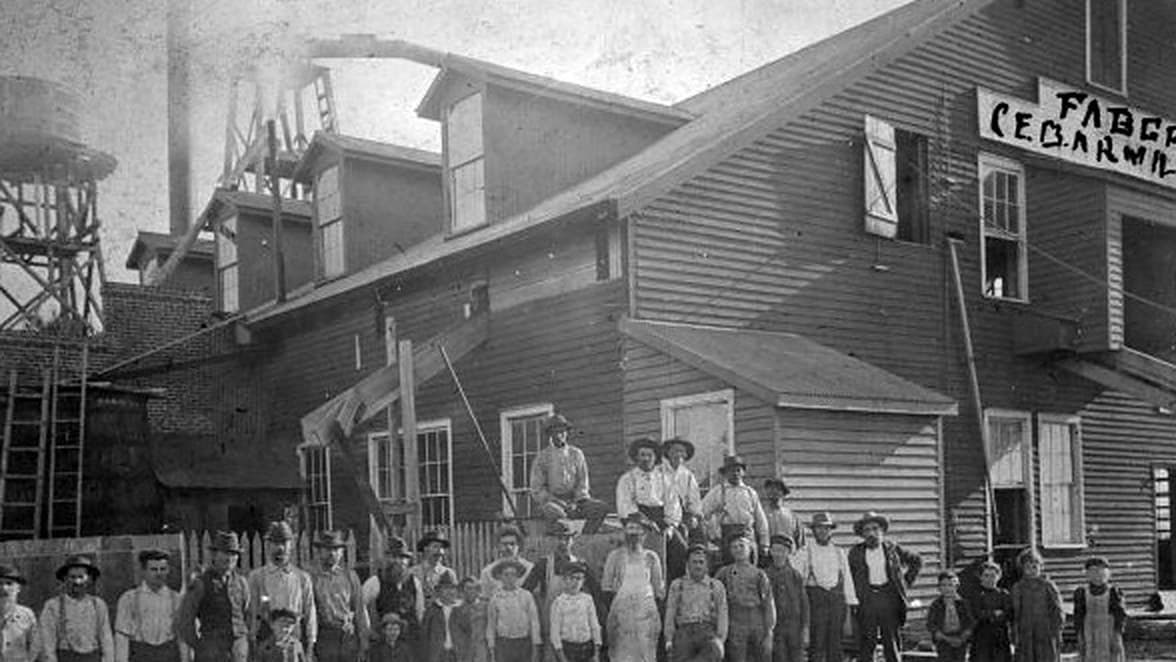
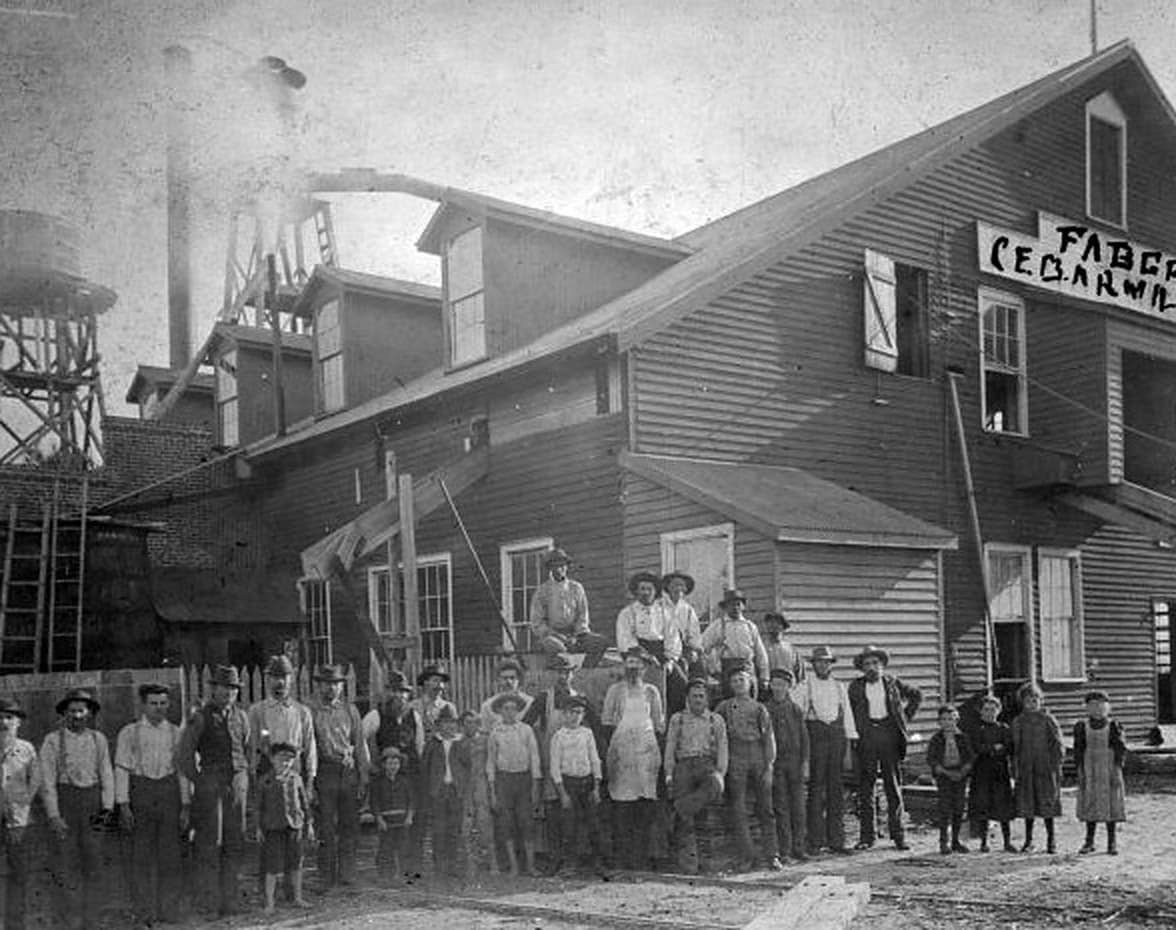
On January 29, 1896, the crew of the Faber cedar mill at Cedar Key came out and stood in front of it for a photograph. About forty of them, men in vests and hats, boys in the front row, a few girls in dresses, some sitting up on a pile of logs. The mill had been sawing red cedar into pencil slats on that island for a generation, and the slats went north to a factory on the East River in New York. Eight months later, before dawn on September 29, the Gulf of Mexico stood ten and a half feet above its normal level and came across the Cedar Keys. By October there was no mill.
The tree was southern redcedar, Juniperus silicicola, a juniper that grows within thirty miles of salt water from the Carolinas around the Gulf to Texas. It takes to limestone and old shell mounds at the edge of the tidal marsh, and it grew thick in the Gulf Hammock between the Suwannee and the Withlacoochee. The heartwood is fine grained, soft, light and fragrant, and a knife runs through it without splintering. It is one of the few woods good for making pencils.
Faber's Island
Eberhard Faber was born in 1822 in Stein, outside Nuremberg, where his family ran the A. W. Faber pencil works. He came to New York in 1848 and opened a stationery store on William Street the next year, selling the family's pencils and hunting American cedar for the German factory. He found it on the Gulf coast of Florida, and by the mid 1850s he had bought land and timber rights around the Cedar Keys.
In 1858 he built a slat mill on Atsena Otie Key, a low island half a mile off Way Key. Crews cut cedar in the hammocks, floated the logs down to the coast, lashed them into rafts and towed them across to the mill, where the saws reduced them to slats. Slats took a fraction of the ship space that logs did, and the first cargoes went to Germany. The 1860 census counted 215 people in thirty households on the island.
The railroad changed the arithmetic. David Levy Yulee, a United States senator from Florida, had chartered the Florida Railroad in 1853 to run from Fernandina on the Atlantic to the Gulf, and construction began in 1855. The first train reached Cedar Key on March 1, 1861, 156 miles from Fernandina, the first railroad across the peninsula, six weeks before the war. That same year Faber opened his own factory on the East River at the foot of 42nd Street, on the ground where the United Nations now stands; the company has called it the first pencil factory in the country ever since. After the war the Atsena Otie mill was rebuilt, and by one count it was turning out casings for a third of a million pencils a year.
The Eagle Pencil Company, founded in New York in 1856 by Daniel Berolzheimer, another emigrant from Franconia, built its own factory there in 1868 and in 1876 put up a slat mill on Way Key, at Third and G streets. The Cedar Key Historical Society counts seventeen sawmills in the town in 1886, cutting close to half a million board feet a week. John Muir had walked in from Kentucky in the fall of 1867 and taken a job at Hodgson's sawmill; malaria put him in bed within three days and kept him there for months.
Two things were already going wrong. The cedar was running out. By the time Faber died in 1879 the mill had nearly exhausted the supply, and the Forest Service's silvics manual later put the matter in a sentence: the species was virtually eliminated as an overstory tree in the nineteenth century, cut primarily for pencils, and the live oaks left standing have kept it from coming back. The railroad business was leaving too. Henry Plant had wanted Cedar Key for the Gulf end of his system and could not get it, so he built to Tampa. His South Florida Railroad opened the full line from Sanford to Tampa on January 25, 1884, and two years later his steamships for Havana sailed from Tampa. By the summer of 1896 about 1,200 people lived on the keys, with two pencil mills still running.
The Morning of September 29
The hurricane formed near the Leeward Islands around September 22, crossed the Caribbean south of Jamaica, came through the Yucatan Channel on the 28th and turned north-northeast, moving fast. The National Weather Service's reconstruction gives it winds of 125 miles an hour at landfall and a central pressure of 960 millibars, and it reached the Cedar Keys about four in the morning on September 29. The sponge fleet took it first. Boats working the grounds off the keys had run for the coves, and over a hundred of them were swamped; one headline that week read "Scores of Spongers and Fishermen Went Down With Their Boats." The surge measured 10.5 feet at Cedar Key and 12.6 feet at the mouth of the Withlacoochee, where Yankeetown stands now.
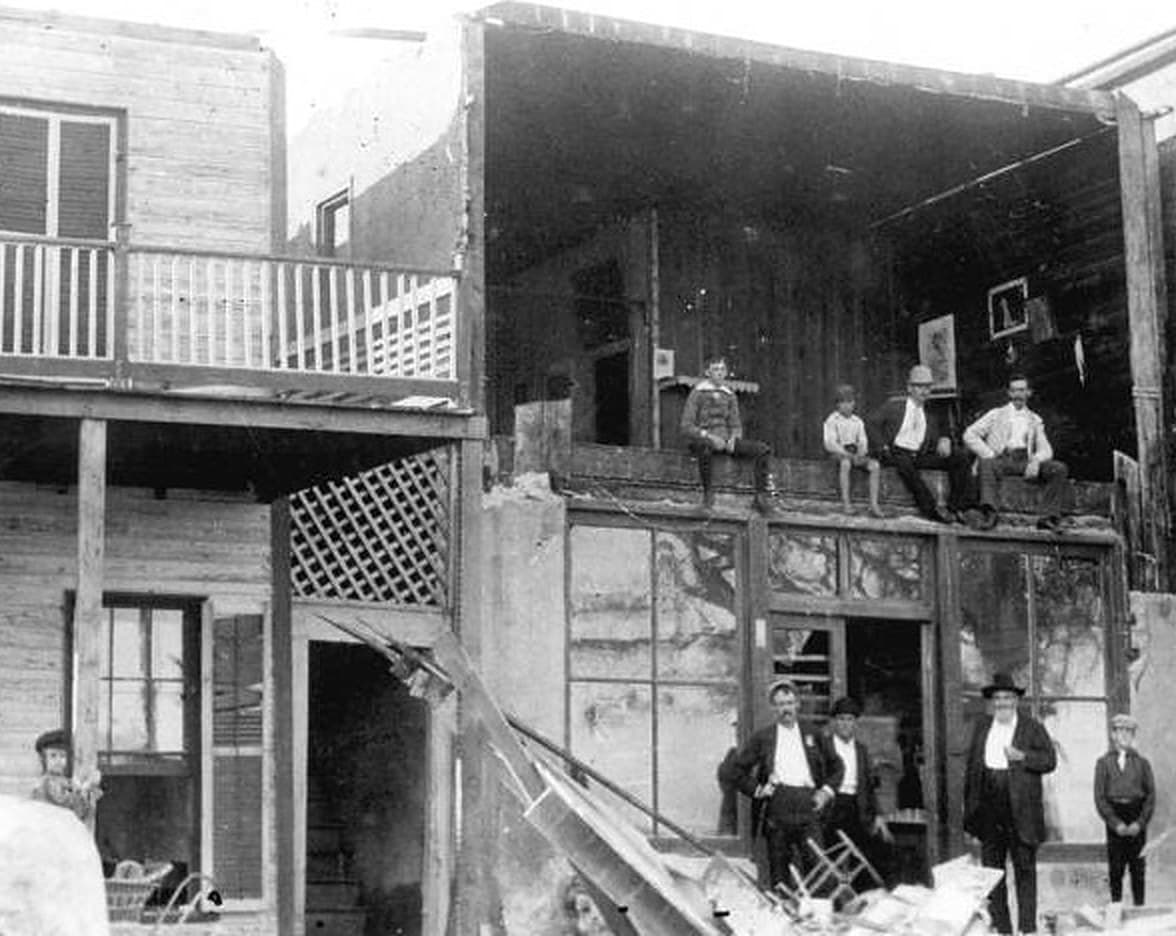
It took the whole of Atsena Otie. Nearly every building on the island was wrecked or carried off, the Faber mill with them; one newspaper tally put the company's loss at 3,000 cases of slats and timber, about $40,000. On Way Key the Eagle mill was ruined, at least a hundred houses were destroyed, and the trestle that carried the railroad across the flats to the mainland washed out. Thirty-one people died on the islands.
The storm went on across Levy County into the pine woods, flattening some 5,000 square miles of timber worth about $1.5 million and shutting down the turpentine camps. About a hundred people died in Florida. The hurricane kept its speed and most of its strength across Georgia and the Carolinas and up through Virginia and Pennsylvania, and killed 202 people in eight states and Washington. "Cedar Keys is a place of desolation and death," a New Hampshire paper reported on October 3. A fire in December took much of what the water had left.
Southern redcedar was virtually eliminated as an overstory species during the 19th century by harvesting, primarily for the manufacture of pencils.
What Was Left
Neither company rebuilt. There was no cedar left to justify it, and the trade was moving on; by the 1940s pencil makers had switched largely to incense cedar. Families on Atsena Otie floated the houses that had survived across the channel to Way Key and pulled lumber out of the mill wreckage for new ones. By 1910 no one lived on the island, and the last wooden house was torn down in the 1940s. The last train left Cedar Key on July 7, 1932. In 1997 the Suwannee River Water Management District bought Atsena Otie, and the Fish and Wildlife Service manages it as part of the Cedar Keys National Wildlife Refuge, the thirteen islands Herbert Hoover began setting aside for nesting birds in 1929. A trail runs in from the beach past a brick cistern to the cemetery, where marble stones from the 1880s stand under live oaks that have grown up among the graves. Ken Sassaman, the University of Florida archaeologist mapping the house foundations by drone, calls the island's end a large storm and a human-made vulnerability crashing into each other.
The town lived another century on mullet and nets. In November 1994 Florida voters, 71.7 percent of them, approved a constitutional amendment banning gill nets in state waters. It took effect on July 1, 1995, and Cedar Key's fishermen were out of work. A retraining program started that year for displaced net fishermen, Project WAVE, taught them to grow hard clams on leased bottom. In 1991 the area had grown no clams at all. In 1997 it sold about fifty million, worth $7.5 million to the farmers, and when the USDA took its first aquaculture census in 1998 Florida led the country. Today about 150 growers harvest 100 to 125 million clams a year on leases off Levy and Dixie counties, 80 to 90 percent of Florida's farmed clams. The Gulf still collects. Idalia in 2023, Debby and Helene in 2024, three hurricanes in thirteen months, stripped the leases; one farmer planted 1,500 bags and found thirty of them afterward. The Faber crew in the January photograph were standing on Atsena Otie. What stands there now is the cistern, the stones and the oaks.
Questions people ask
- Who built the pencil mills at Cedar Key?
- Two New York pencil companies. Eberhard Faber, sent from the family's German pencil works to find American cedar, bought land and timber rights around the Cedar Keys in the 1850s and built a slat mill on Atsena Otie Key in 1858. It cut southern redcedar logs into pencil slats, which went to Germany at first and, after he opened his own factory on the East River in 1861, north by Yulee's railroad to New York. The Eagle Pencil Company, founded in 1856, built a second slat mill on Way Key in 1876 at Third and G streets. Both mills were destroyed on September 29, 1896, and neither was rebuilt.
- What happened to Cedar Key in the 1896 hurricane?
- A hurricane with winds of about 125 miles an hour came ashore at the Cedar Keys around four in the morning on September 29, 1896, pushing a storm surge of 10.5 feet above mean sea level. Nearly every building on Atsena Otie was wrecked, including the Faber mill; on Way Key the Eagle mill was ruined, at least a hundred houses were destroyed and the railroad trestle to the mainland washed out. Thirty-one people died on the islands, about a hundred in Florida, and 202 in all as the storm ran on through Georgia, the Carolinas, Virginia and Pennsylvania. A fire that December took much of what was left. Atsena Otie was empty by 1910.
- Why does Cedar Key farm clams?
- Because the nets were taken away. In November 1994 Florida voters approved a constitutional amendment banning gill nets in state waters, and when it took effect on July 1, 1995, Cedar Key's mullet fishermen lost their living. A retraining program called Project WAVE taught displaced net fishermen to grow hard clams in mesh bags on leased bottom. The area grew no clams in 1991; by 1997 it sold about fifty million, and in the first USDA aquaculture census in 1998 Florida led the country. Today about 150 growers harvest 100 to 125 million clams a year off Levy and Dixie counties, 80 to 90 percent of Florida's farmed clams.