
history · 7 min
The Royal Poinciana, the Largest Wooden Hotel Ever Built
Henry Flagler's Palm Beach hotel took 1,000 men nine months to raise in 1893 and a crew of 102 unemployed men over a year to pull down.
By The Editors ·
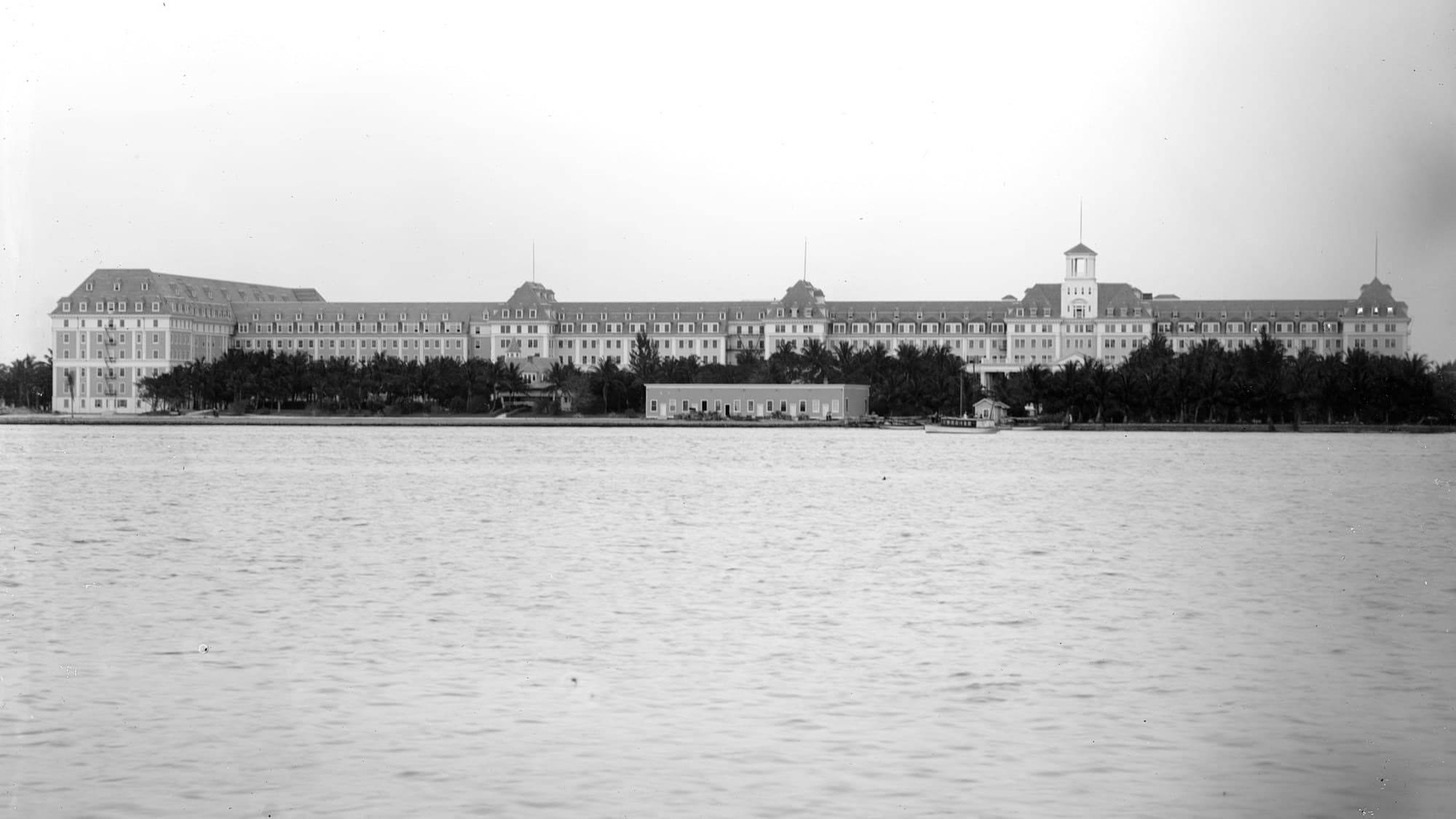
On February 11, 1894, the Royal Poinciana took in seventeen guests. It had 540 rooms for them. The paint was weeks old, the railroad had not yet reached the lake, and the way to the door was by train to Titusville, steamer down the Indian River, and boat the rest of the way, about thirty hours from Jacksonville. A correspondent for a Delaware weekly called it the biggest hotel on the East Coast and put its capacity at nearly a thousand. Henry Flagler was not finished with it.
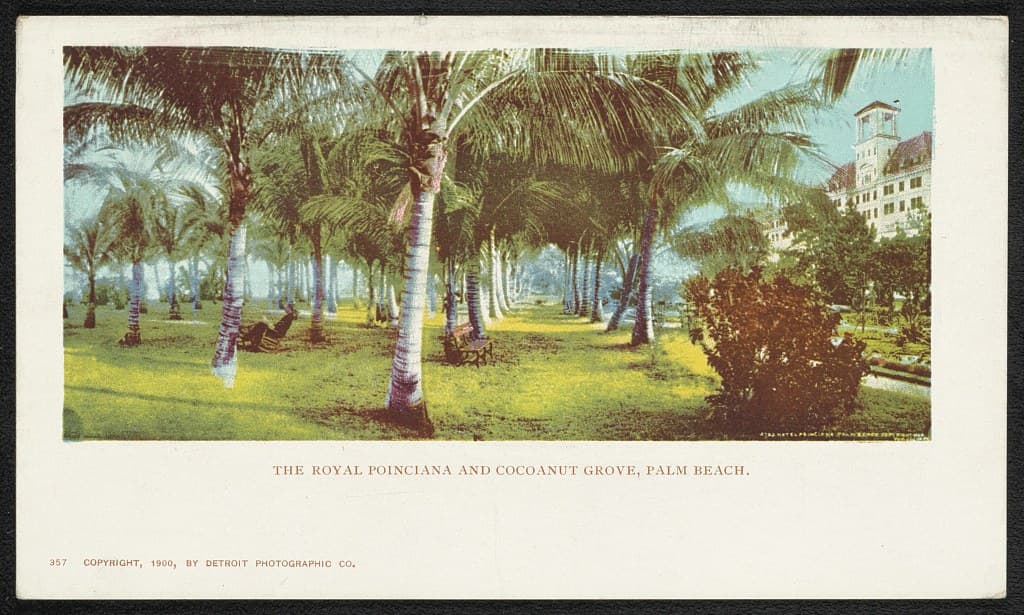
He had settled on the place less than a year earlier. In March 1893 Flagler spent three days on Lake Worth, picked out what he wanted, and left an agent, Albert Robert, to buy it: $50,000 for Brelsford Point, $75,000 for Robert McCormick's lake-to-ocean tract and the house on it, which Flagler lived in while the hotel went up beside it. Ground was broken on May 1. McGuire and McDonald, his St. Augustine builders, ran about 1,000 men through the summer and fall. The bill of materials ran to 1,400 kegs of nails, 360,000 shingles, half a million feet of lumber, and 2,400 gallons of paint. The result was six stories in the Colonial style of the day, yellow with white trim, and a Detroit Photographic color print from 1900 still shows it that way through the coconut palms.
Across the lake there was almost nothing. Flagler had a county surveyor plat 48 blocks for a service town in November 1893, and on February 4, 1894, a week before the hotel opened, the lots were auctioned in the Royal Poinciana ballroom. A year earlier there had been one house on the site. Now there was an ice plant nearly ready to run, two saloons already open, a doctor building an office, a drugstore, and an undertaker preparing for the worst. West Palm Beach incorporated that November, 77 votes to 1. The hotel's first public event had been the sale of the town that would wait on it.
Three Miles of Corridor
The railroad reached West Palm Beach in late March 1894, and by 1896 a 1,200-foot trestle carried it across the lake to the hotel's south side, where an orchestra met the trains. The richest guests came in their own railway cars and lived in them on the hotel siding. Additions in 1899 and 1901 took the building to 1,081 rooms along three miles of corridor and 1,800 feet of lakefront, with room for close to 2,000 guests, a staff of about 1,400, and a dining room the state marker credits with 1,600 seats. Rooms ran from $6 to $100 a night. Bellboys carried messages by bicycle because the hallways were too long to walk. It was called the largest wooden building in the world.
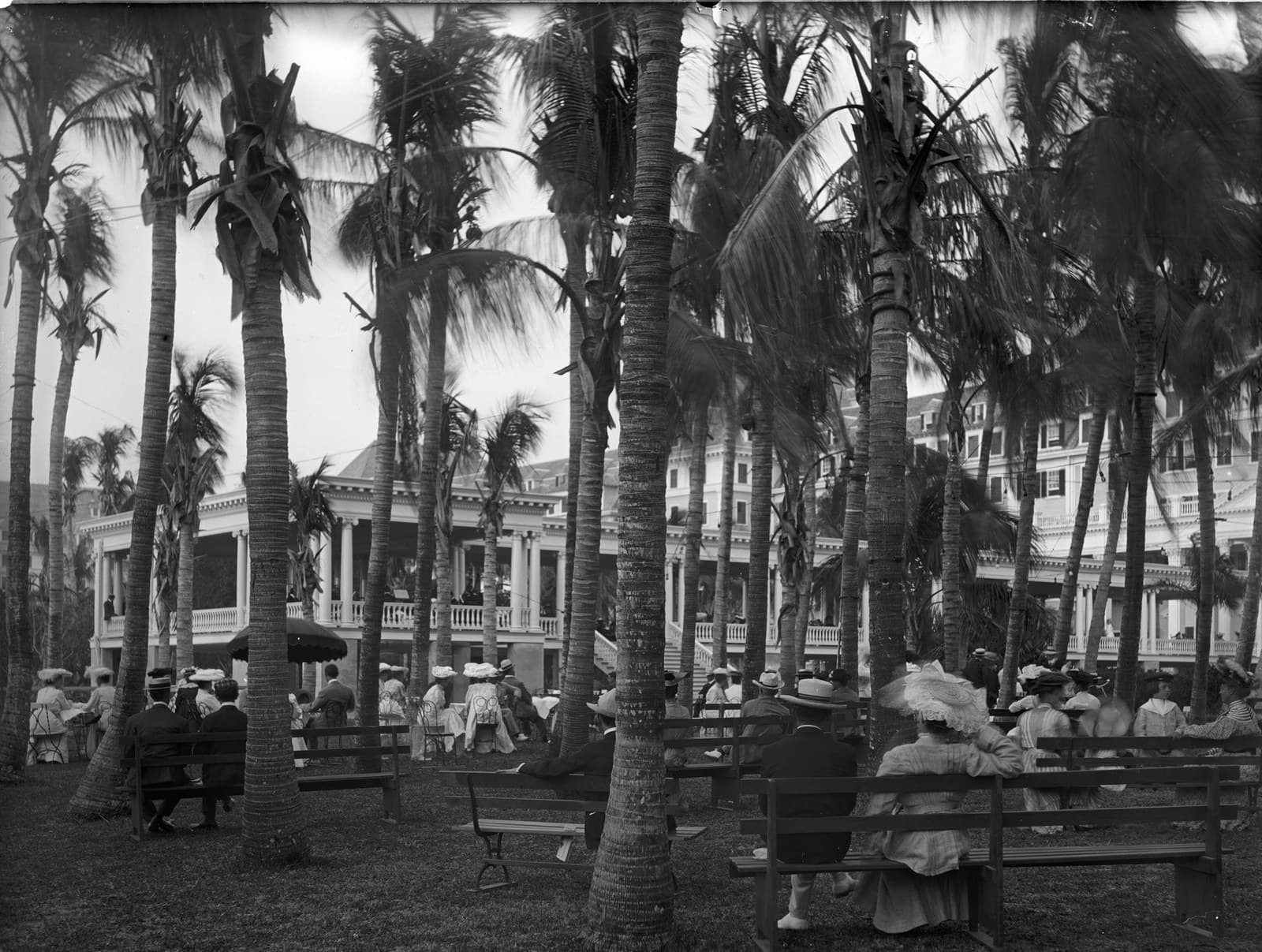
The season opened in January, peaked at the Washington's Birthday ball on February 22, and emptied through March. Afternoons went to the lawn concert and tea in the Cocoanut Grove. Once a week the hotel's Black employees staged a cakewalk under palms strung with colored lights, competing for a frosted cake and cash before a thousand guests. The island's transport was a wicker chair with a bicycle bolted behind it and a Black hotel worker pedaling. Guests called them Palm Beach chariots, lazy-backs, and by the 1920s Afromobiles; a 1925 magazine counted a thousand of them. They rolled down the pine walk to the ocean, where Flagler had opened a second hotel in January 1896. He renamed it the Breakers in 1901, after the rooms guests kept asking for. The Breakers burned on June 9, 1903, reopened in February 1904, burned again on March 18, 1925, and came back in December 1926 as the building that stands today.
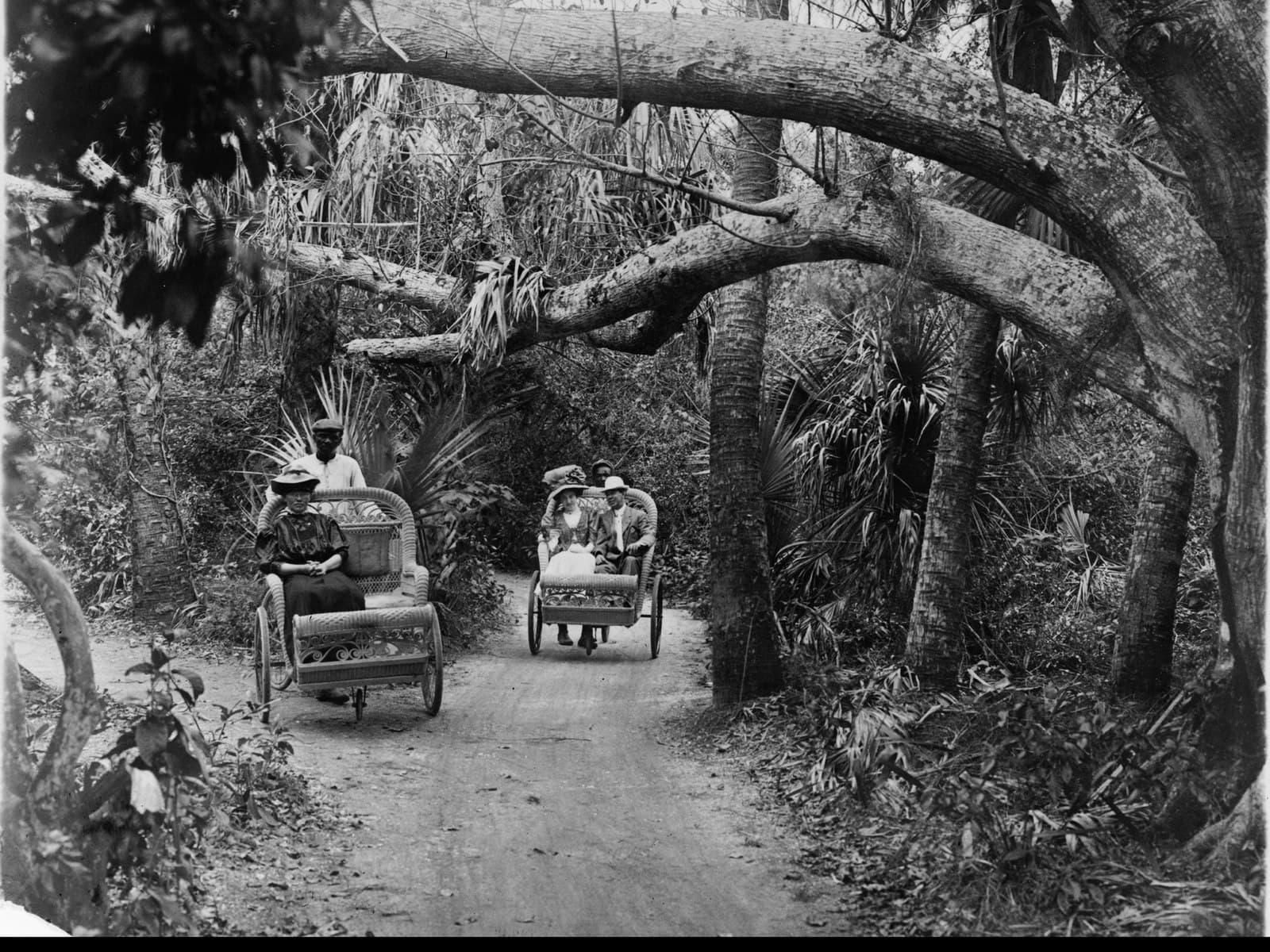
In 1902 Flagler finished Whitehall next door, a marble house by Carrère and Hastings built as a wedding present for Mary Lily Kenan. The railroad bridge had run between the hotel and the ground the house needed, so the tracks were moved to the hotel's north side and a north wing went up beside them. The Historic American Buildings Survey lists the Flaglers' guests at Whitehall: the Duke and Duchess of Manchester, Nellie Melba, Enrico Caruso, Admiral Dewey, Woodrow Wilson, Elihu Root, John Jacob Astor. Detroit Publishing photographed the actor Joseph Jefferson in a Palm Beach wheelchair about 1904.
The Styx
The men who built the hotel, and the men and women who ran it each winter, lived north of it. Flagler's Black laborers, many from the Bahamas and the Caribbean, others from states to the north, built a settlement around what are now Sunset and Sunrise avenues on land belonging to Henry Maddock, E. M. Brelsford, and Dr. James M. Munyon, who charged $3 a month ground rent. The white construction camp was elsewhere. People called the place the Styx. Legend puts 2,000 people in it. The 1900 census found about a hundred Black residents on the whole lake outside West Palm Beach, and the Historical Society thinks the Styx probably never held more than 200 at a time.
The story told for a century is that Flagler lured the residents to a circus in West Palm Beach and burned the Styx behind them. The Historical Society and the Preservation Foundation of Palm Beach have both looked for the fire and found no record of one. What the records show is slower. Munyon's land passed in 1910 to the gambler E. R. Bradley and his brother, and by February 1912 the Bradleys had cut the 30 acres into 230 building lots. The remaining tenants were given two weeks to leave. Most went to the Northwest neighborhood of West Palm Beach and to Pleasant City, platted in 1905 with streets named Comfort, Cheerful, and Easy, where a lot could be had for $150. The houses came down after they left.
1928
The hurricane of September 16, 1928 came ashore at Palm Beach. In the Royal Poinciana it brought plaster down in more than 1,400 rooms and shifted the north wing off its foundation. The Palm Beach Post reported on October 13 that the hotel would not open that winter. It did, on January 12, 1929, with 600 rooms in use. That summer most of the broken north wing was razed and replaced with two pergolas and a conservatory, and the hotel that reopened in full in January 1930 held about 900 guests against 1,200 before the storm. The stock market had crashed in between. The hotel opened for the last time in January 1932, stayed dark in 1933 and 1934, and on August 15, 1934, the Florida East Coast Hotel Company decided to take it down.
The contractors Scott and Whittaker paid between $65,000 and $75,000 for the salvage rights to the main building and had until December 1, 1935 to clear it. The contract left out three things: the north wing, the colonnades, and the greenhouse. A Miami auction house began selling the contents in early September to about 4,000 buyers, by a later count. By late November, 102 men, most of them hired off the county's unemployed rolls, had a third of the hotel on the ground in stacks of Florida pine described as free of termites and virtually as good as when it was nailed in place in 1894. Eliot Kleinberg of the Post counted at least 40 houses built from the lumber and parts of hundreds more. The main building was gone by the end of 1935. The north wing stood until 1937.
The contract left out three things: the north wing, the colonnades, and the greenhouse.
What Stands There
By the Historical Society's reckoning, Cocoanut Row now runs through the ground the ballroom stood on. Palm Beach Towers, an apartment hotel finished in 1956, holds the lakefront, and the Royal Poinciana Plaza, which John Volk designed for John S. Phipps in 1957, fills the rest. The greenhouse the wreckers were told to leave alone is still there, a wooden slat house at 50 Cocoanut Row. One other piece got away. The hotel's tea house went down the lake by barge to Hypoluxo as a guest cottage, passed through a gambling club and a trailer park, and since 2011 has stood at the Church of the Holy Guardian Angels in Lantana as the Chapel of the Holy Spirit. The state marker in front of the Towers, put up in 1961, gives the last season as 1930 and the demolition as 1936. The Post's own files say January 1932, the end of 1935, and 1937 for the wing.
Questions people ask
- When was the Royal Poinciana Hotel built, and how big was it?
- Henry Flagler broke ground on May 1, 1893, and the hotel opened on February 11, 1894, with 540 rooms and seventeen guests. About 1,000 men built it in nine months from half a million feet of lumber, 360,000 shingles and 1,400 kegs of nails. Additions in 1899 and 1901 took it to 1,081 rooms along three miles of corridor and 1,800 feet of Lake Worth shoreline, with room for close to 2,000 guests and a seasonal staff of about 1,400. It was six stories of wood, painted yellow with white trim, and was called the largest wooden building in the world.
- Why was the Royal Poinciana Hotel demolished?
- Two blows landed a year apart. The hurricane of September 1928 brought plaster down in more than 1,400 rooms and shifted the north wing off its foundation, and the hotel reopened in 1930 with capacity for about 900 guests instead of 1,200. Then the Depression emptied it. It opened for the last time in January 1932, stayed dark in 1933 and 1934, and on August 15, 1934, the Florida East Coast Hotel Company sold the salvage rights for $65,000 to $75,000. Wrecking began that fall with 102 men hired from the county unemployed rolls. The main building was gone by the end of 1935 and the north wing in 1937.
- What is left of the Royal Poinciana Hotel today?
- One building on the site: the hotel greenhouse, left out of the 1934 wrecking contract, now the Slat House at 50 Cocoanut Row inside the Royal Poinciana Plaza. The hotel's tea house also survives, moved by barge to Hypoluxo and later to Lantana, where it is now the Chapel of the Holy Spirit. Palm Beach Towers, finished in 1956, and the Royal Poinciana Plaza, designed by John Volk in 1957, occupy the hotel grounds, and Cocoanut Row runs through the site of the ballroom. Whitehall, Flagler's 1902 house next door, is the Flagler Museum, and a state marker from 1961 stands at 44 Cocoanut Row.