
news · 9 min
Blue Spring in January
In the winter of 1970-71 eleven manatees sheltered in a spring on the St. Johns River. This past winter the morning roll call passed 850.
By The Editors ·
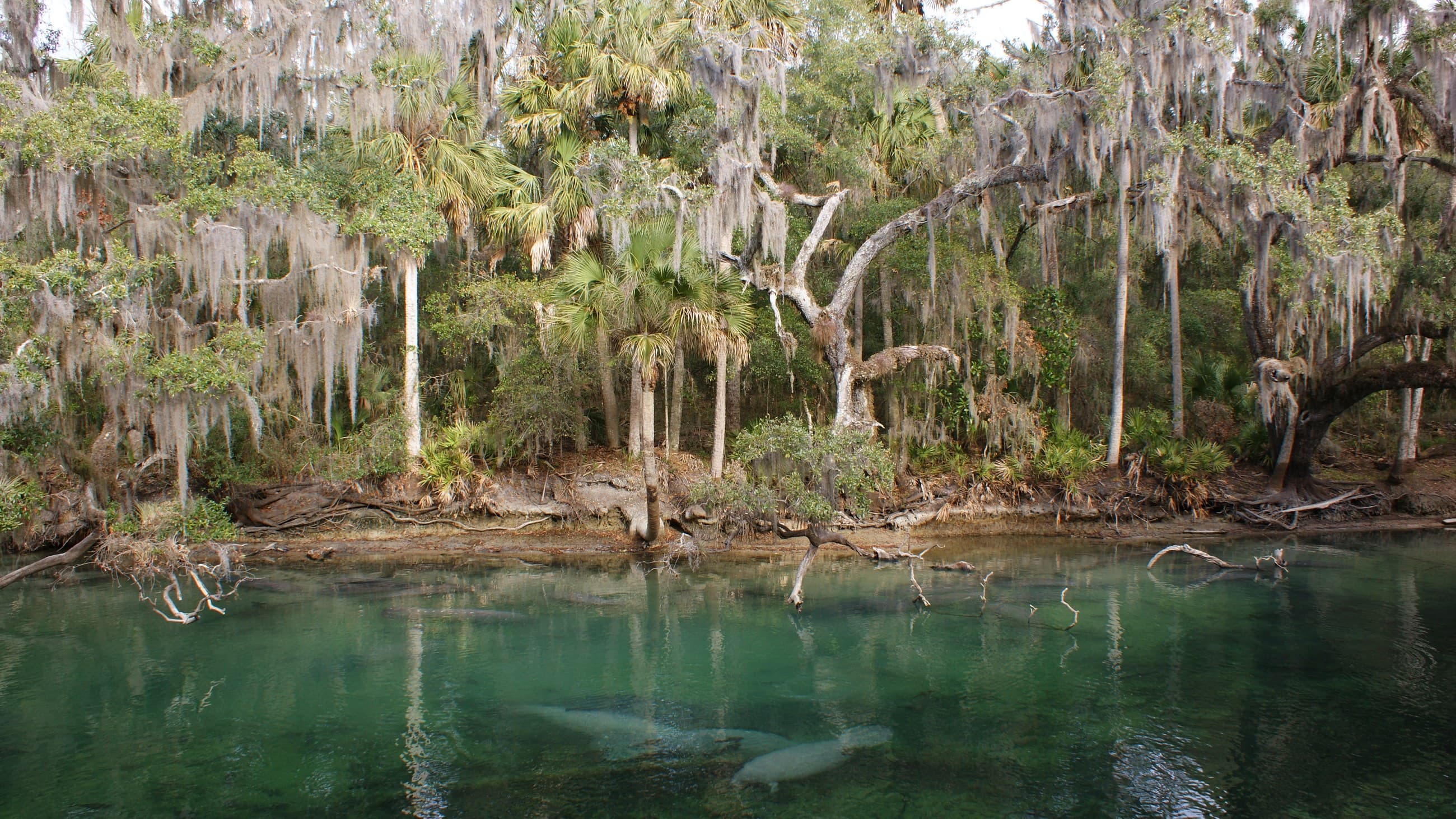
Every winter morning from November to March, before the park gates open, Wayne Hartley pushes a canoe into the run at Blue Spring State Park and starts counting. He has been doing it since 1978, first as a park ranger and, since 2010, for the Save the Manatee Club. He counts every manatee in the run, writes down which ones he recognizes by the scars on their backs, notes the new calves, and posts the total. Save the Manatee calls it roll call. On February 2, 2026, with the St. Johns River at 56 degrees, the roll call came to 834, and the club's summary of the season would put the winter's high at 859. In his first season, in 1978, he counted 35.
That is the whole story in two numbers, and it is a story Florida does not get to tell often. A place that was nearly lost, and an animal that was nearly lost with it, and fifty years later both are doing better than anyone who was there at the start would have guessed.
The Spring
Blue Spring is a first magnitude spring on the east bank of the St. Johns, at the western edge of Orange City in Volusia County. The water comes up out of a vent about twenty feet below the surface, at a long term average of roughly 100 million gallons a day, and runs a little under half a mile through a cypress and palm hammock before it meets the river near Hontoon Island. It comes up at 72 degrees, in January and in July.
That constant temperature is the reason for everything that follows. A manatee has almost no body fat for its size and cannot stand cold water for long. Below about 68 degrees the animals begin to suffer what biologists call cold stress, and a hard winter without shelter kills them. So when the river drops into the fifties, they come up the run and sit in the spring water like people around a stove, and they stay there until the river warms again.
People have been coming to the spring for as long as there have been people. John Bartram, the Philadelphia botanist, wrote it up on his trip along the St. Johns in 1766. Louis Thursby, who had gone to California for the gold rush, settled on the inlet in 1856, built one of the first steamboat landings on the upper river, planted an orange grove, and in 1872 put up the two story house of Savannah pine that still stands beside the spring, with a third floor his son added around 1900. For a generation Blue Spring Landing was a stop for the boats coming up from Jacksonville. Then the railroad came through in the 1880s and ended the steamboat trade, the freezes of the 1890s took the grove, and the landing became a quiet place again.
The Forgotten Mermaids
In the winter of 1970-71 Jacques Cousteau brought the Calypso's crew to Blue Spring to film manatees. There were eleven of them wintering in the run that year, and the film shows what they were up against: swimmers riding them, boats over them, people who had never seen one treating them as a curiosity. The episode was called The Forgotten Mermaids. It ran on ABC on December 21, 1971, in the Undersea World series, one of the most watched documentary programs on American television, and it did for the manatee what nothing else had.
The state bought the spring and the land around it in 1972 and made it a park, and the Save the Manatee Club, which keeps the genealogy of every animal that has ever used the run, credits the film directly. The eleven manatees Cousteau filmed became the first entries in that genealogy. One of them was a female the club named Phoebe. She weighed over 2,000 pounds, she came back to the spring for more than twenty winters, until her death in 1992, and her daughter Phyllis, born in 1985, produced the first twins ever recorded at Blue Spring in 1991 and went on to have sixteen calves. Phyllis was seen at Blue Spring again on May 13 of this year. A bull named Brutus, close to 1,900 pounds, has been a regular since 1970. Howie has been coming since 1971.
What Changed
The manatee had been on the federal endangered list since 1967, before the Endangered Species Act itself existed, but a listing does not warm a river or keep a boat off an animal's back. The things that made a difference at Blue Spring were specific and local.
The park closed the run to swimming, diving, and boats during the cold months, from November 15 to March 15, and extended the closure whenever manatees were still in the water. In 1976 the federal government designated the spring as critical habitat. In 1978 the legislature passed the Florida Manatee Sanctuary Act, which declared the entire state a refuge for the animal and let the state set boat speeds on its behalf. The rule for the St. Johns around Blue Spring dates from March 1979, and as it stands today it sets idle speed on the river between markers 69 and 75 all year and bars motorboats from the run entirely from October 15 to April 15.
Then somebody had to count. Hartley started the season count in 1978 and became the principal investigator on the spring's manatees in 1980. Every animal that uses the run gets a number, a name, and a scar chart, and by the 2011-12 season he was identifying or re-identifying more than 400 individuals a winter. In 1981 Jimmy Buffett and Governor Bob Graham founded the Save the Manatee Club, and when Hartley retired from the park service in 2010 the club hired him the same month so the count would not stop. It has not.
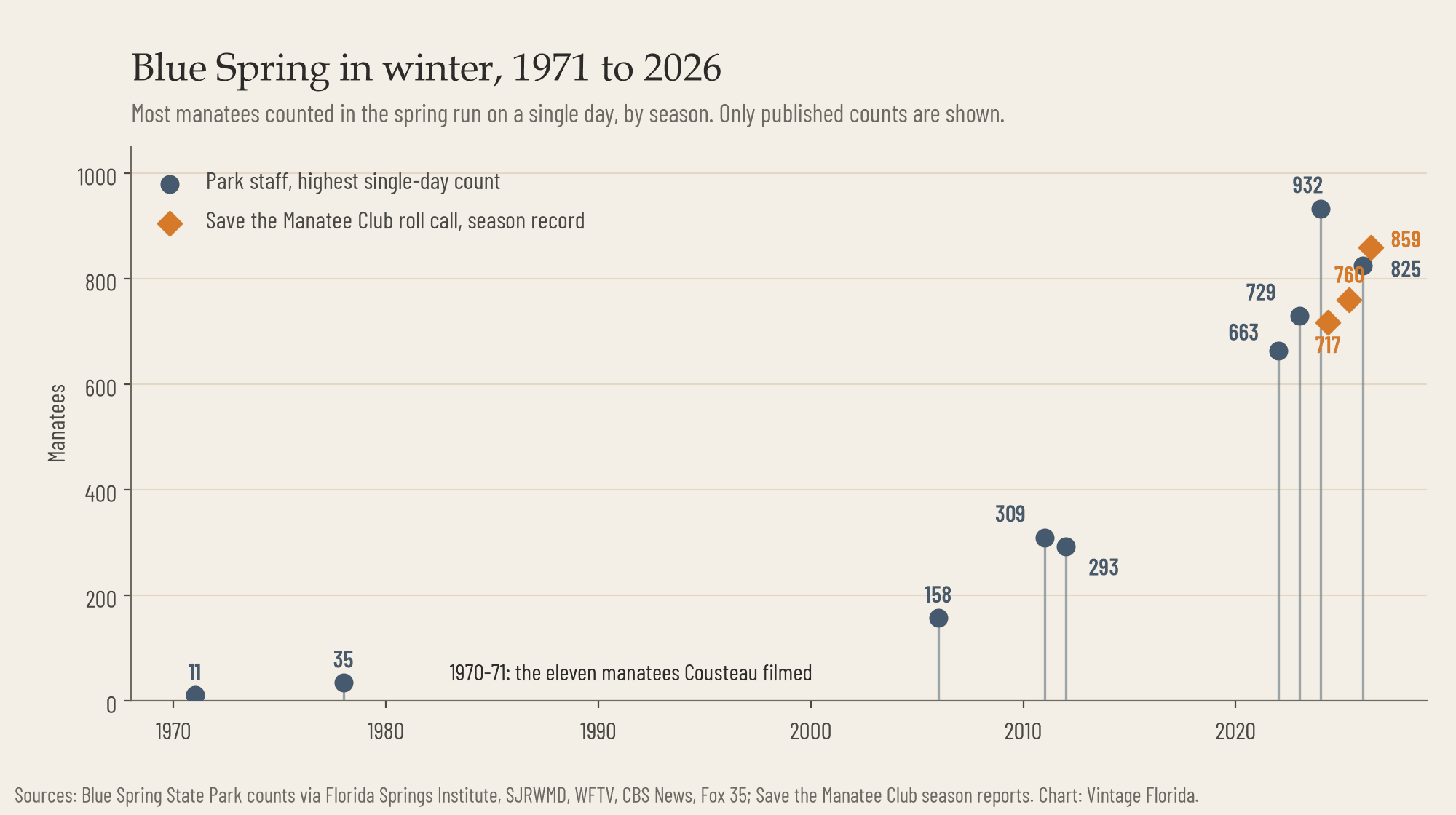
The numbers moved slowly and then fast. Eleven in 1970-71. Thirty-five in Hartley's first winter. The water management district's engineers, writing a minimum flow rule for the spring in 2006, recorded a season high of 158 and projected, at the growth rate they were seeing, 558 by 2024. The 2010-11 season topped 300. On January 18, 2022, park staff counted 663 on a single morning. In January 2023 they counted 729. And on January 21, 2024, with the river at 58.8 degrees, the park counted 932 manatees in the run at once. The Save the Manatee canoe count that day was 679, and 717 the day after, which Hartley wrote up as the highest one-day count he had ever taken part in. The count ran two thirds above the engineers' projection.
On January 21, 2024, with the river at 58.8 degrees, the park counted 932 manatees in the run at once.
The 2024-25 season set the club's own record, 760 at roll call on January 26, 2025, the second morning of the Orange City manatee festival. When Hartley added up the season that April, 879 different manatees had used the run, 545 of them returning from the winter before, with 88 calves. Every number was a record except the calves, which had been 93 the season before. This past winter the roll call reached 755 on January 20, 770 the next day, and 834 on the second of February, and the club's season summary recorded a high of 859. The park's own boardwalk count on January 19 was 825.
Why Blue Spring
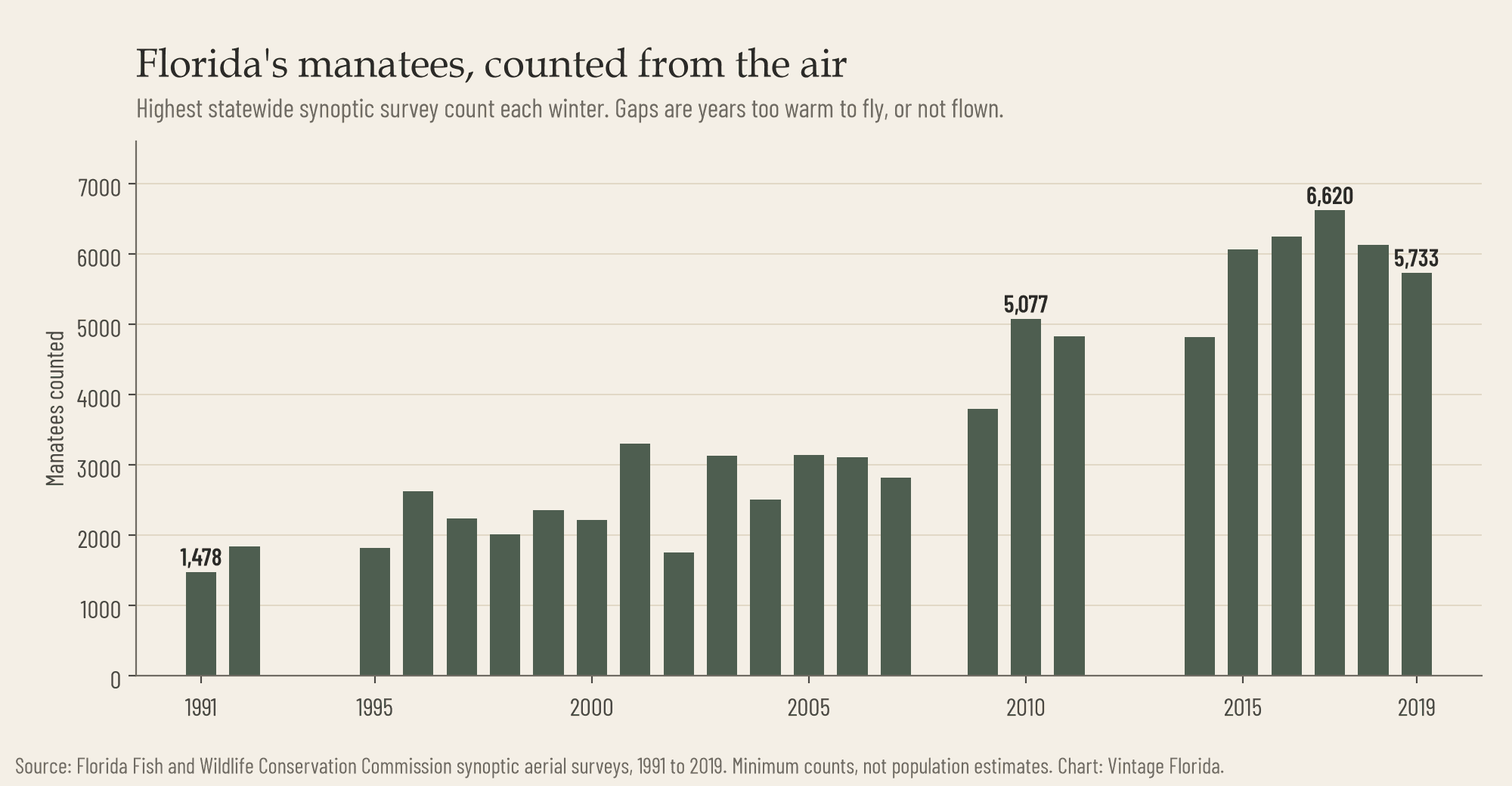
Part of the answer is that there are more manatees. The state's aerial surveys, flown on cold mornings when the animals bunch up in warm water, counted 1,267 on their first flight in January 1991, 1,478 a month later, and 6,620 in the winter of 2017. The newer method, which corrects for the animals the planes miss, put the population at somewhere between 8,350 and 11,730 in the winter of 2021-22. In 2017 the federal government moved the species from endangered to threatened.
Part of it is that Blue Spring is one of the few natural warm places left. The Marine Mammal Commission estimates that about two thirds of Florida's manatees now winter in the warm outfalls of power plants, and only about 18 percent use springs, chiefly Blue Spring and Kings Bay at Crystal River. The power plants will not run forever. Some of the units the animals depend on are decades old, and when they close, the springs are what remain. Every manatee that learns the way to Blue Spring as a calf is one that will know where to go.
And part of it is that the good years at Blue Spring have overlapped with the worst years anywhere else. Between December 2020 and April 2022 the state recorded 1,255 dead manatees, most of them on the Atlantic coast, in what the federal government declared an Unusual Mortality Event. The cause was starvation. The seagrass in the Indian River Lagoon had died off, and animals that wintered there had nothing to eat. State and federal staff and volunteers fed lettuce to manatees at a power plant in Brevard County for two winters, more than 600,000 pounds of it. The year 2021 was the deadliest on record, 1,101 manatees. The lagoon is a long way from Blue Spring, and the herd there is mostly a river population, though a few tagged animals have been tracked between the spring and the coast. The St. Johns still has grass, and the spring has never had more visitors.
What Is Still Wrong
A good news story about Florida water has to say where the catch is, and there are two. The first is the boats. Watercraft killed 98 manatees in 2025, a quarter of all the deaths the state examined, and the total death count that year was 632, which is lower than the famine years but still above where it stood a decade ago. The second is the spring itself. The Florida Springs Institute's accounting puts Blue Spring's flow from 2007 to 2017 at about 135 cubic feet a second, against a long term average near 155, and the water management district's minimum flow for the spring, the line below which it says harm begins, rose to 157 cubic feet a second in 2024. The spring is at or below that line more often than it used to be. It takes about 100 million gallons a day of 72 degree water to keep eight hundred manatees alive through a freeze, and that water comes out of the same aquifer that Orange City, DeLand, and Deltona drink from.
Going
The park drew 575,769 visitors in the 2022-23 fiscal year, who spent about 69 million dollars in the area, and the winter mornings are the reason. On a cold day in January the line at the gate has run past an hour and the park has closed at capacity by mid morning. Starting July 15, 2026, day visitors need a reservation, booked up to sixty days ahead. The boardwalk runs about a third of a mile from the river to the head spring, with viewing platforms over the run, and on the coldest mornings the water below the platforms is grey with backs.
The Orange City Blue Spring Manatee Festival, run by volunteers since the 1980s, takes over Valentine Park on a weekend in late January, with a free shuttle to the spring. And if you cannot get there, the Save the Manatee Club has had cameras above and below the water in the run since 2011, paid for at the start by a memorial gift, and streams them free with Explore.org all winter. On a cold morning you can watch the roll call happen.
Hartley is still in the canoe. He closed out the 2025-26 season in March, wrote the summary in June, and will be back on the water when the river drops in November. Somewhere in the run, if the pattern holds, Phyllis will be there too, with her seventeenth calf, in water that has been 72 degrees every day since Cousteau's cameras found her mother in it.
Questions people ask
- How many manatees are at Blue Spring?
- It depends on the morning and the cold. The record for a single day is 932, counted by park staff on January 21, 2024, with the river at 58.8 degrees. The Save the Manatee Club's canoe roll call, taken every winter morning before the gates open, passed 850 in the winter of 2025-26. In the winter of 1970-71 there were eleven. The club and the park post the daily count through the season.
- When is manatee season at Blue Spring?
- The park closes the run to swimming, diving and boats from November 15 to March 15, and longer whenever manatees are still in the water. The animals come into the run on cold mornings, when the St. Johns River is colder than the spring, so the biggest counts come on the coldest days of December, January and February.
- Why do manatees go to Blue Spring?
- For the temperature. The spring comes up at 72 degrees in January and in July, at a long term average of roughly 100 million gallons a day, and runs a little under half a mile to the St. Johns River. When the river cools in winter the manatees gather in the run to stay warm. The federal government designated the spring critical habitat in 1976, and the Florida Manatee Sanctuary Act of 1978 let the state set boat speeds on the animals' behalf.