
news · 6 min read
Is Florida Still the Orange State?
By act of the Legislature, three times over. By the numbers, California grows the oranges and Brazil squeezes the juice. A short answer to a question the license plate raises.
By The Editors ·
The question comes up because of the license plate. The standard Florida plate that started shipping in January of this year carries an orange blossom, and underneath it the county name, the motto In God We Trust, or the words Sunshine State, whichever the buyer picks. It has said Sunshine State, on and off, since 1949, when the Florida Chamber of Commerce got the slogan onto the plates. The state had been the last of the old forty-eight to issue a uniform tag at all, in 1918. The Florida Handbook says the 1970 Legislature made the nickname official; the statute book does not mention it. There was one detour. In 1951 the plates said Keep Florida Green, and the state dropped it after a year because tourists took it to mean their money.
So the plate says sunshine and shows a blossom, and a fair number of people, in Florida and out of it, would tell you the state is the Orange State. Is it?
What the law says
By law, the orange is about as official as a plant can get. The 1909 Legislature chose the orange blossom as the state flower. In 1967 the Legislature adopted the juice of the mature orange, Citrus sinensis and its hybrids, as the official state beverage, chapter 67-4. In 2005 it named the orange itself the state fruit, chapter 2005-38, so the fruit, the flower and the glass have each been adopted by the Legislature, though only the fruit and the glass made it into the statute book. What is not on the books, and never has been, is the phrase Orange State. Chapter 15 of the statutes, where the symbols live, has no nickname section of any kind.
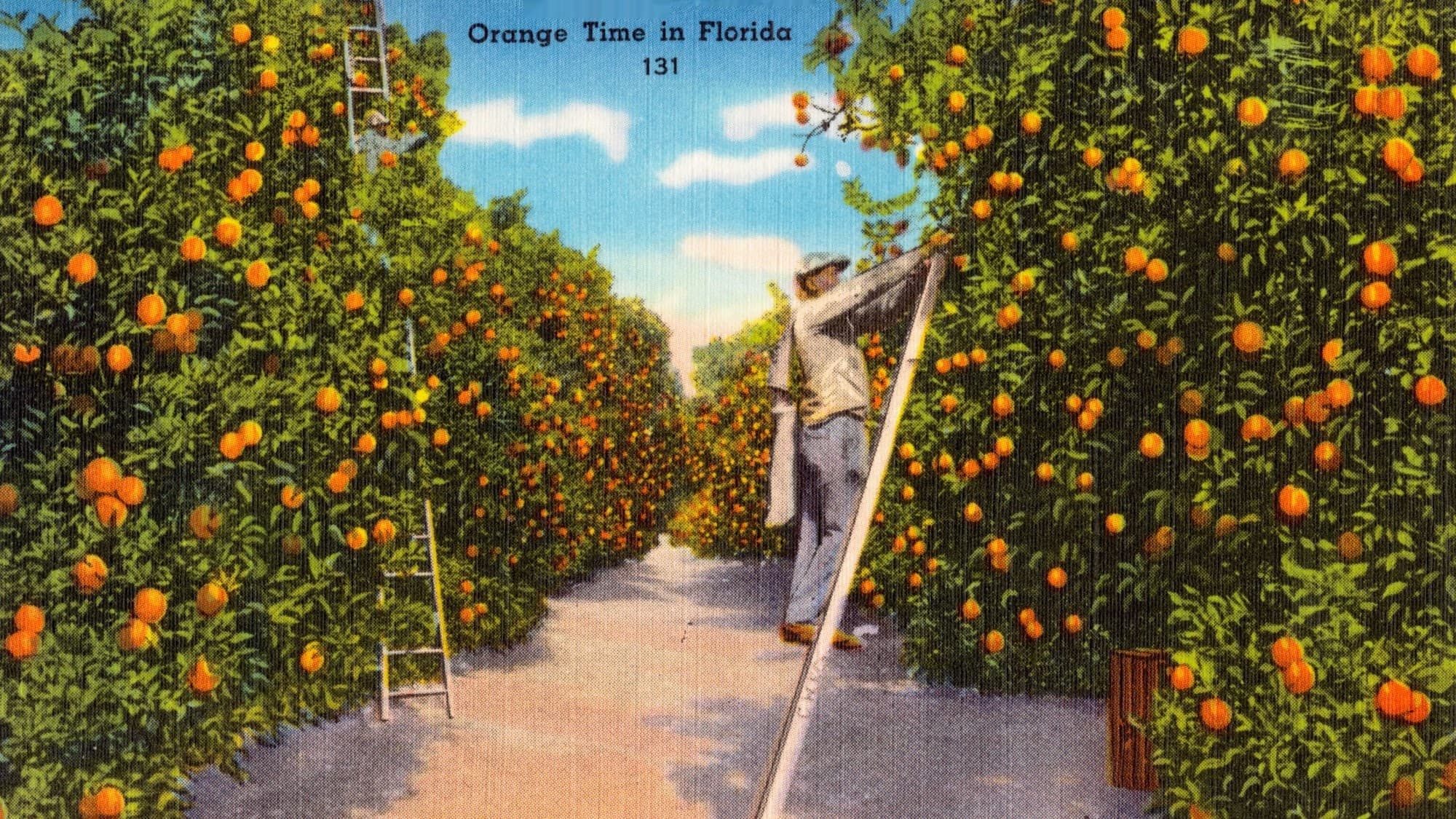
The name belongs to newspapers and promoters, and it is older than most people think. In December 1893 a paper in Grenada, Mississippi, reporting that Governor Henry Mitchell was trying to stop the Corbett-Mitchell prizefight, said he had his big foot down on the sport in the orange state. The fight went ahead in Jacksonville the next month anyway. By July 1913 the Ocala Evening Star could print a Tampa story saying that Florida, long known as the orange state, was about to take a middle initial, C for corn, so eager were its farmers for the crop. The phrase was already an old one when the linen postcards in our archive were printed, and even then the state was reaching for a second name.
What the groves say
The numbers are the reason the question has an edge to it now. Florida picked 244 million boxes of oranges in the 1997-98 season, the record. In the season that ended this summer it picked 12.95 million, by the USDA's August count, which is 5.3 percent of the peak. The commercial citrus inventory published in August found 165,359 acres of citrus of all kinds in the state, down 21 percent in a year and down 79 percent from the 797,303 acres counted in 2002. Every one of the twenty-three counties the survey reports lost ground. Polk County lost the most, 10,944 acres, and still leads the state with 37,529.
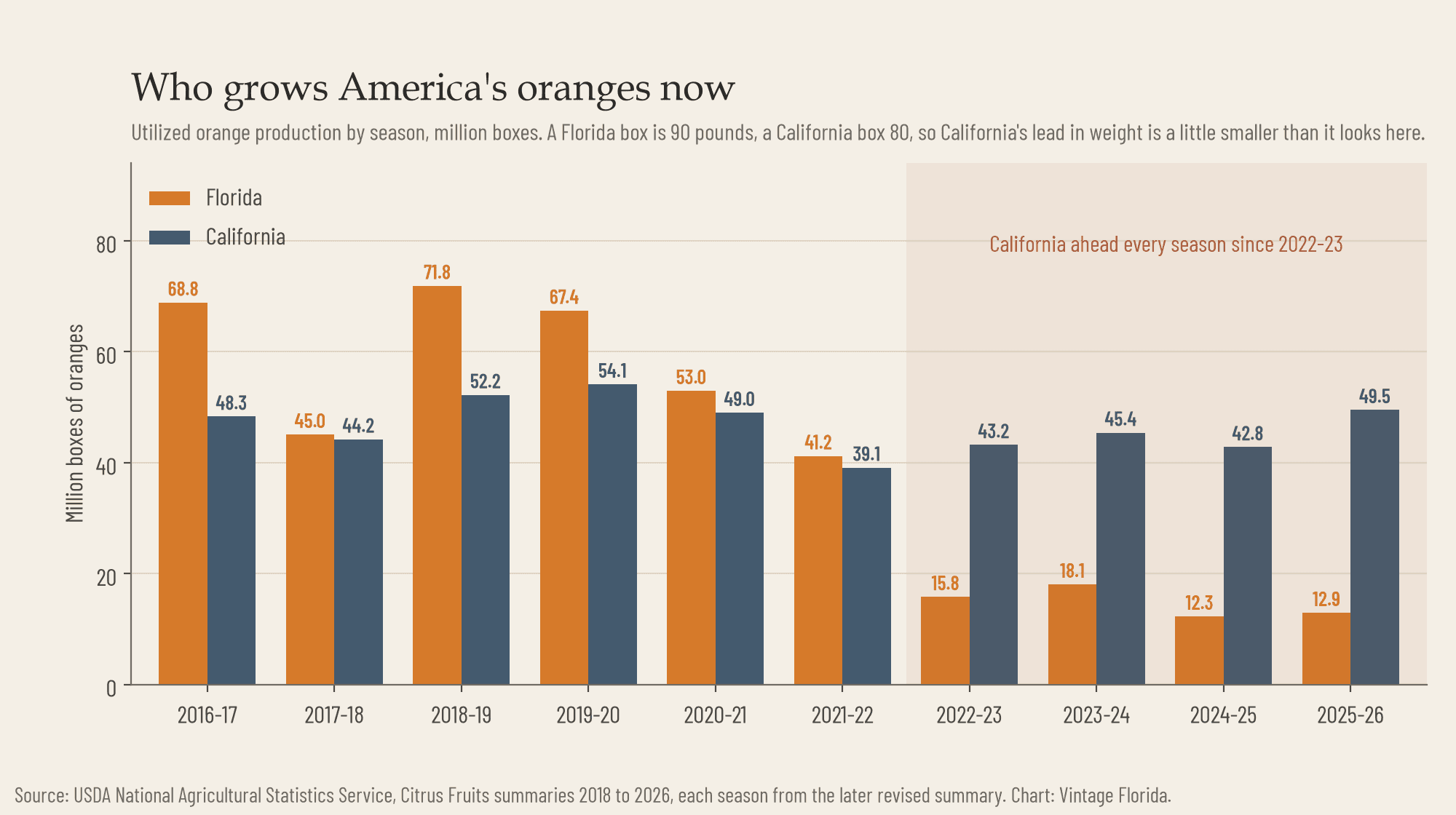
California passed Florida in oranges in the 2022-23 season, on the USDA's final figures, and has stayed ahead since. In 2025-26 California picked 49.5 million boxes, about 1.98 million tons; Florida's 12.95 million boxes weighed about 582,000 tons. The two states are not really in the same business. About two thirds of California's oranges are sold as fruit. About nine tenths of Florida's go to the processing plant, which is why the state fruit and the state beverage are the same thing here. Counting all citrus, grapefruit and tangerines and lemons included, California now grows 84 percent of the American crop and Florida 13 percent.
What is in the carton
The juice has moved further than the fruit. The USDA's Economic Research Service expected American orange juice production in 2025-26 to come to 99 million single-strength gallons, which if it holds would be the lowest in the country's history, and imports to pass 580 million gallons. Brazil and Mexico supplied 94 percent of those imports the season before. In the USDA's world trade figures for this year Brazil ships 973,000 metric tons of the 1.27 million tons of orange juice concentrate that cross a border anywhere, about 76 percent of the trade, and the United States imports more than five times as much juice as it makes. Brazil's main citrus belt, around São Paulo, expects 263 million boxes from the crop now being picked, about twenty for every box Florida picked last season.
The labels have followed the juice. Florida's Natural, the growers' cooperative in Lake Wales, took the word Florida off its premium carton in 2022, and when a West Palm Beach television station asked about it the next year, said in a statement that it was a decision it had not made easily. The new carton lists juice from Mexico and Brazil. In 2023 Tropicana's carton listed oranges from the United States and Brazil; Simply Orange listed California, Mexico and Brazil. The federal Brix standard for pasteurized orange juice was lowered this August, from 10.5 degrees to 10, the first time the floor has moved since the standard was written in 1963, at the request of Florida's juice processors, its growers' association and the Department of Citrus, because greening and storms have pushed the sugar in Florida fruit below the old line.
So is it?
By act of the Legislature, yes, three times over, and by memory, which is what the nickname was always made of. By the numbers, the Orange State is now the juice state's supplier of last resort, growing a twentieth of what it grew a generation ago and a twentieth of what Brazil grows now. The Legislature put close to $196 million into citrus in the budget the Governor signed on June 29, most of it, $160 million, for the CRAFT program's grove-scale trials of treatments and growing practices against greening. The Department of Citrus runs on about $23 million a year, raised in part by a box tax of twelve cents on every box of oranges that goes to the plant, and the boxes it has to tax are a twentieth of what they were a generation ago.
The honest answer is that Florida is the Orange State the way Detroit is the Motor City. The name is true about where the thing was made into an industry, and true about what the place still means, and no longer true about who makes most of it. The blossom on the plate is right either way. It is the tree that is in trouble, not the flower.
Questions people ask
- Is the Orange State an official nickname for Florida?
- No. Florida has never adopted it. The state's statutes do not designate a nickname at all; the Sunshine State was put on license plates in 1949, and the Florida Handbook says the 1970 Legislature made it official, but the statute book does not mention it. The Orange State was a newspaper name, in print by 1893, and an Ocala paper was already calling it the state's long-known cognomen in 1913.
- Does California grow more oranges than Florida?
- Yes, since the 2022-23 season on final USDA figures. In 2025-26 California picked 49.5 million boxes, about 1.98 million tons, against Florida's 12.95 million boxes, about 582,000 tons. Two thirds of California's crop is sold fresh; nine tenths of Florida's is squeezed.
- Where does Florida orange juice come from now?
- Mostly Brazil. The USDA expected the country to produce 99 million single-strength gallons of orange juice in 2025-26, the lowest in its history, and to import more than 580 million, with Brazil and Mexico supplying 94 percent of the imports the season before. Brazil exports about three quarters of all the orange juice traded in the world.