
news · 16 min
The Water Under Everything
Florida sits on one of the most productive aquifers on earth. Here is what it was, what it is now, how it got this way, and what it will take to keep it.
By The Editors ·
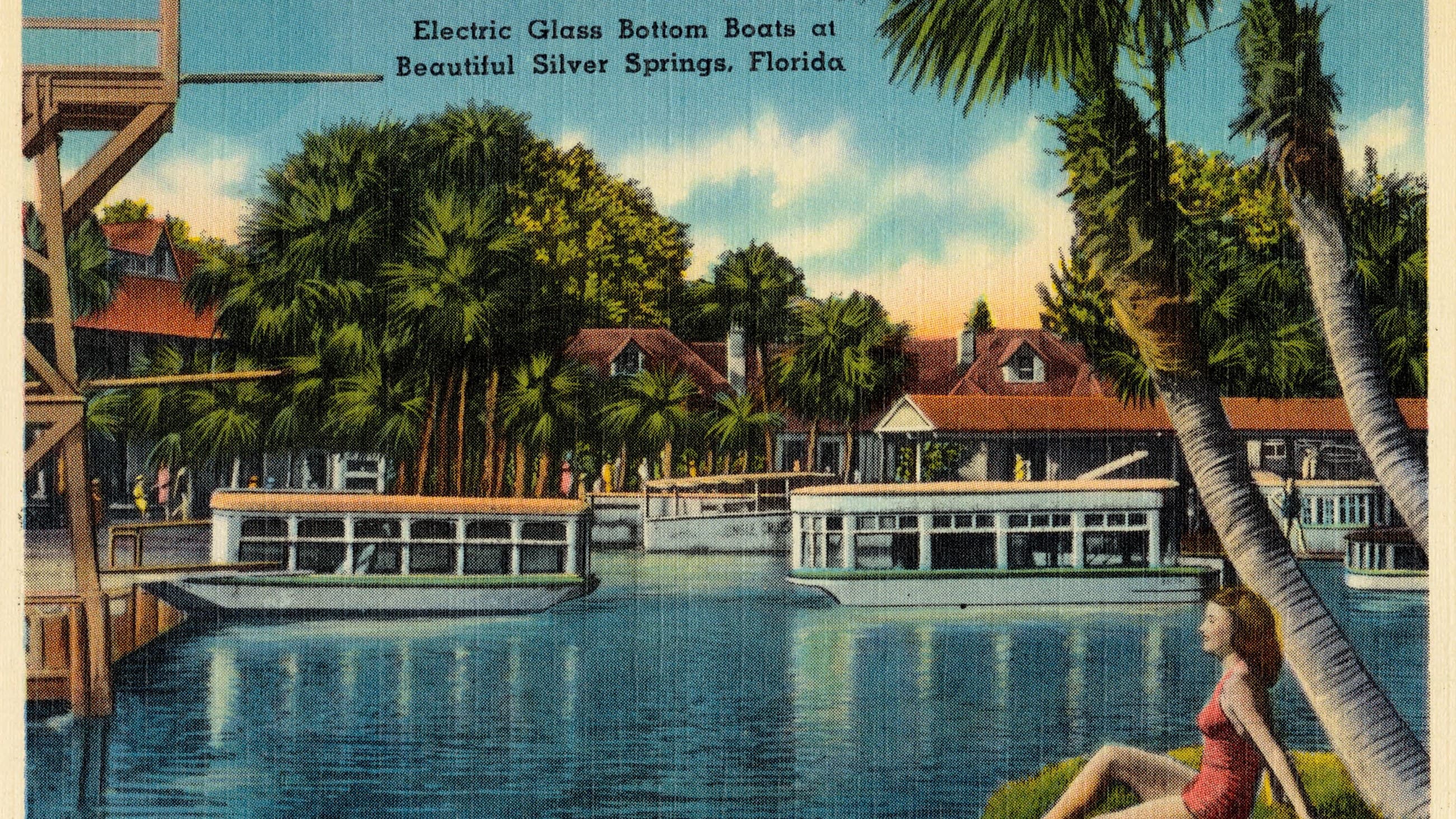
In 1878 a man named Hullam Jones fitted a pane of glass into the bottom of a dugout canoe and pushed off across the head spring at Silver Springs, near Ocala. What he saw through the glass had been there all along, but nobody had looked at it this way. Fish hung in water so clear it seemed to have no surface. Forty feet down, the limestone floor opened into a vent, and out of the vent came a river. The glass bottom boat became Florida's first tourist attraction, and the thing it was built to show, the water itself, became the reason people came.
That water comes from the Floridan aquifer, a body of porous limestone that lies under the whole peninsula and reaches north into Georgia, Alabama, and South Carolina. It covers about 100,000 square miles. In places it is a hundred feet thick, in others more than 3,300. The U.S. Geological Survey ranks it among the most productive aquifers in the world, and in 2015 it supplied close to two thirds of every gallon of groundwater pumped in the state. Groundwater, in turn, was the drinking water for 92 percent of Floridians, some 18.3 million people that year. When you run a tap in Jacksonville, Orlando, Tallahassee, Gainesville, or Tampa, you are drinking the same water that boils up at Silver Springs.
This is an article about the condition of that water. It is longer than what we usually run, because the subject does not reduce well. The short version is that the aquifer is not running out, but the springs that are its visible face are running lower and dirtier than they have in living memory, the causes are known, and the fixes are known too. What is missing is mostly will, and money, and time.
What the Aquifer Is
Florida is a limestone platform. For tens of millions of years the peninsula was a shallow sea floor, and the shells and skeletons of what lived there piled up and hardened into rock. Rainwater is slightly acidic, and over the ages it ate its way into that rock, opening pores, cracks, and eventually whole caverns. The result is a sponge the size of a state. Water moves through it, sometimes a few feet a year through fine pores, sometimes miles a day through underground rivers big enough to swim in.
Geologists divide the system into an Upper Floridan and a Lower Floridan, separated in most places by a less permeable layer. The Upper Floridan does most of the work. In north and central Florida it lies at or near the surface, and rain falling on the sandhills of the Ocala and Brooksville ridges soaks straight into it. The Southwest Florida Water Management District puts recharge at anywhere from 2 to 38 percent of rainfall depending on where the rain falls. Where the aquifer is exposed and the ground is high and sandy, most of a storm goes into the rock. Where it is buried under clay, almost none does.
South of a line running roughly from Tampa to Melbourne, the Floridan dips deeper and turns brackish, and a different, shallower aquifer takes over. The Biscayne aquifer supplies Miami, Fort Lauderdale, and the Keys. This article is about the Floridan, which means it is mostly about the northern two thirds of the state. That is where the springs are.
A spring is simply a place where the aquifer is under enough pressure to push water up through a hole in the rock. Florida has more of them than anywhere else on earth. The Florida Springs Institute counts more than a thousand documented springs. The USGS counts 27 first magnitude springs in the state, springs that discharge at least 100 cubic feet per second, or about 65 million gallons a day, out of 78 in the whole country. The Springs Institute counts 33 when it includes river rises, where a river that has gone underground comes back to the surface.
How It Used to Be
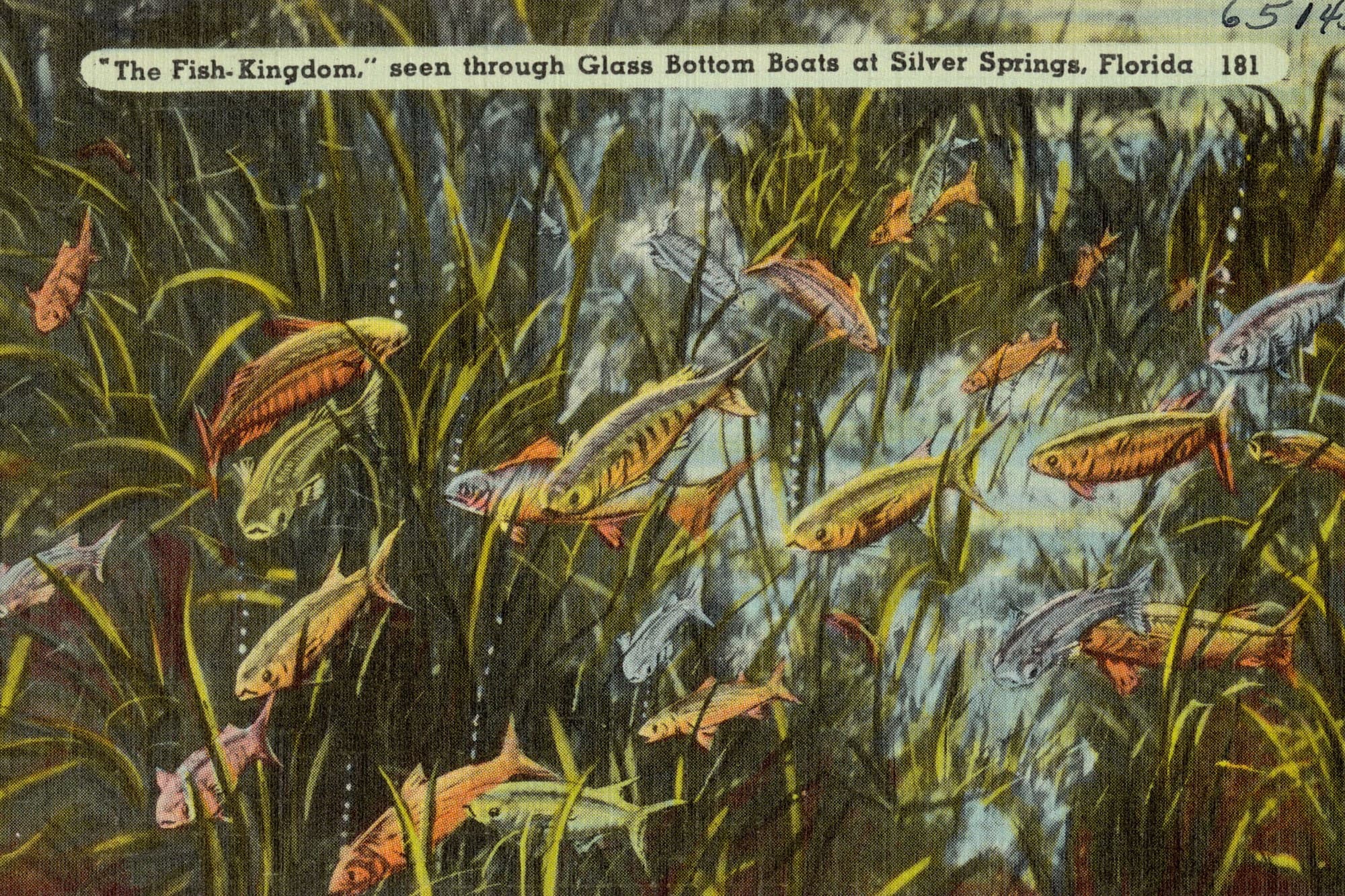
The old Florida ran on springs. Before there were roads there were steamboats, and after the Civil War the boats went up the St. Johns to the Ocklawaha and then up the Silver River to the head spring, where passengers stepped off into a place that looked like nothing else in America. Harriet Beecher Stowe made the trip. So did Ulysses S. Grant. Silver Springs was, for a while, the most famous natural attraction in the South, and it was famous for its clarity.
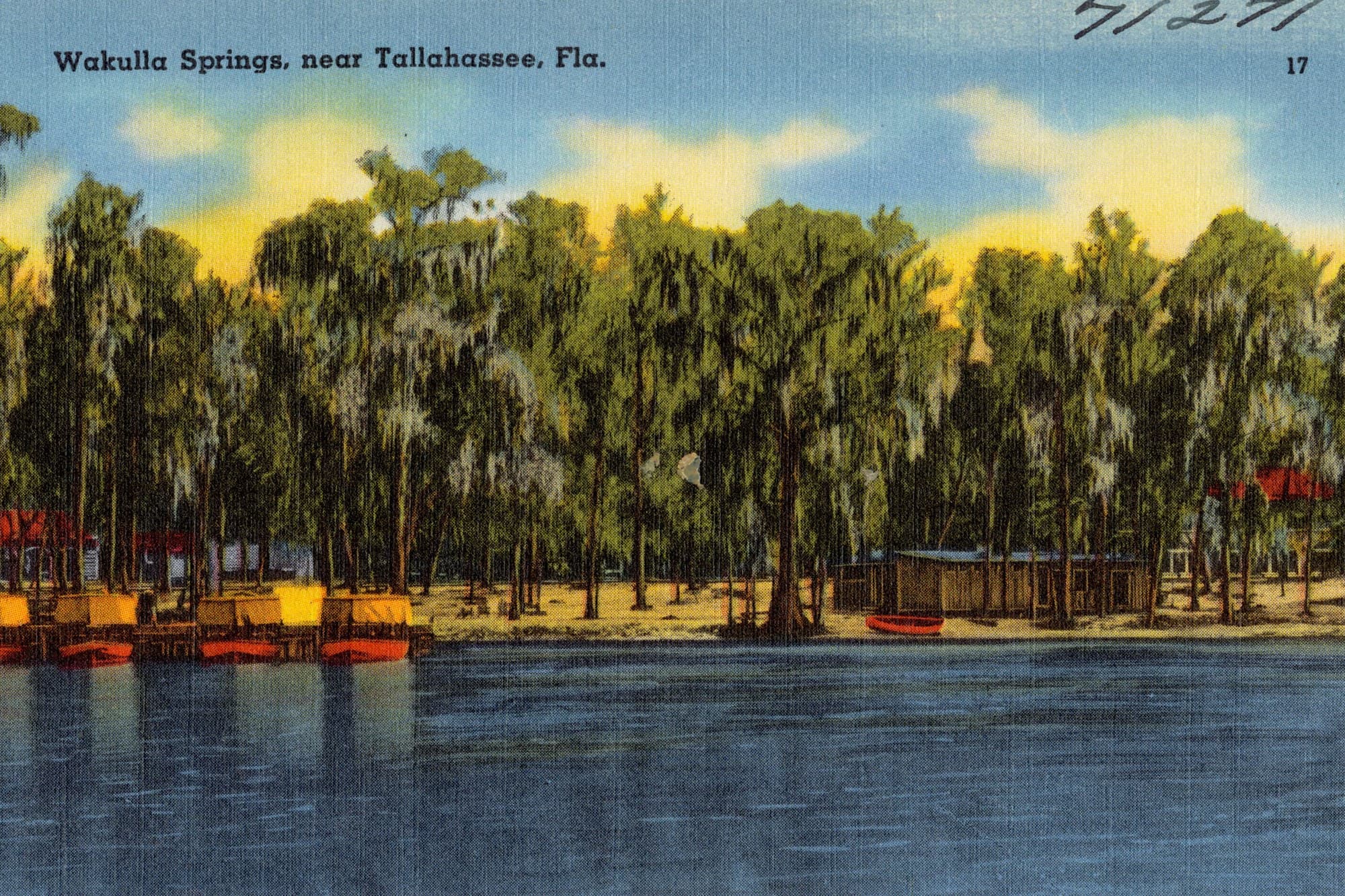
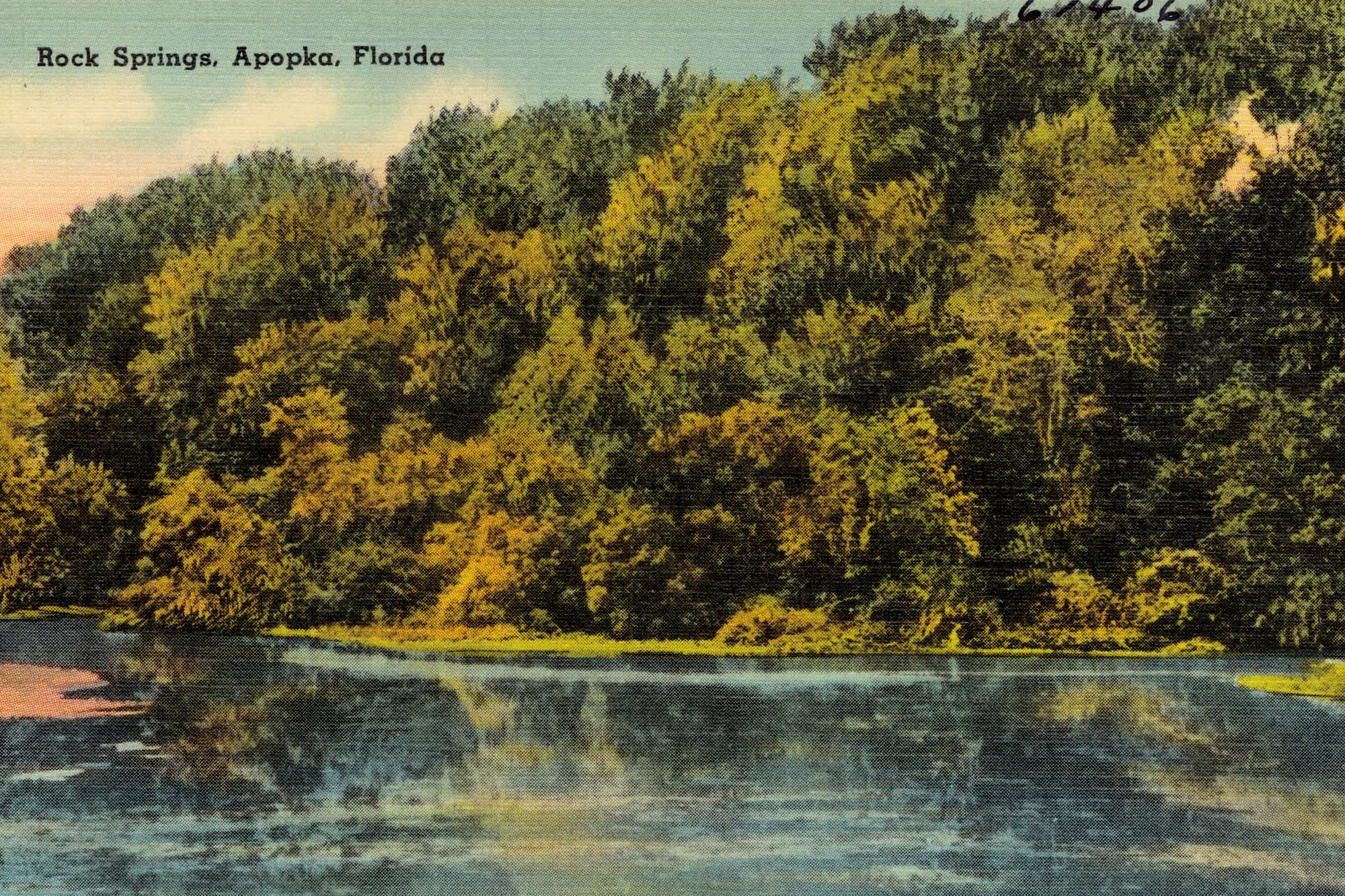
Clarity was the point everywhere. At Wakulla, south of Tallahassee, the spring was deep enough that a mastodon skeleton was pulled out of it in 1930, and visitors on glass bottom boats could see the bones of others still on the bottom. Weeki Wachee opened its underwater theater in 1947, with mermaids performing in a vent that ran so clear the audience forgot there was water between them and the stage. Rainbow Springs near Dunnellon, Ichetucknee near Fort White, Rock Springs north of Apopka, the sulphur spring at White Springs on the Suwannee: every one of them drew a crowd because the water was cold, blue, and transparent to the bottom.
The chemistry of that water was very close to rain. The Springs Institute estimates that before the land around them was developed, the springs carried roughly 0.04 milligrams of nitrate nitrogen per litre. Green algae was a scarce thing in a Florida spring. The bottom was white sand, limestone, and eelgrass, and the eelgrass was where the fish were.
The aquifer was full. Along the coasts, artesian wells drilled into the Floridan flowed on their own, without a pump, because the pressure in the rock was higher than the ground. Towns grew up around that convenience. In the Tampa Bay area and along the Atlantic from Jacksonville to Daytona, the flowing well was as ordinary a feature of a farm as the barn. The USGS says the aquifer was recognized as a single regional flow system only in the 1930s, which means Florida was already a century into pumping it before anyone had mapped where the water came from or where it went.
The Draw
Two things happened at once after the Second World War. Florida filled up with people, and those people, along with the farms and factories and power plants that came with them, began pulling water out of the ground faster than anyone had before.
The numbers come from the USGS, which has compiled a water use report for Florida every five years since 1950. That year the state had 2.77 million people and withdrew about 1,450 million gallons of fresh water a day, less than half of it from wells. By 1980 there were 9.75 million people and the state was drawing about 6,700 million gallons a day, with more than half now coming from the ground. The USGS atlas of the Floridan puts withdrawals from that single aquifer at about 630 million gallons a day in 1950 and about 3 billion gallons a day by 1980, a fivefold increase in thirty years. Polk County alone, with its phosphate mines and citrus, pumped 310 million gallons a day from the Floridan in 1980. Orange County pumped 200 million.
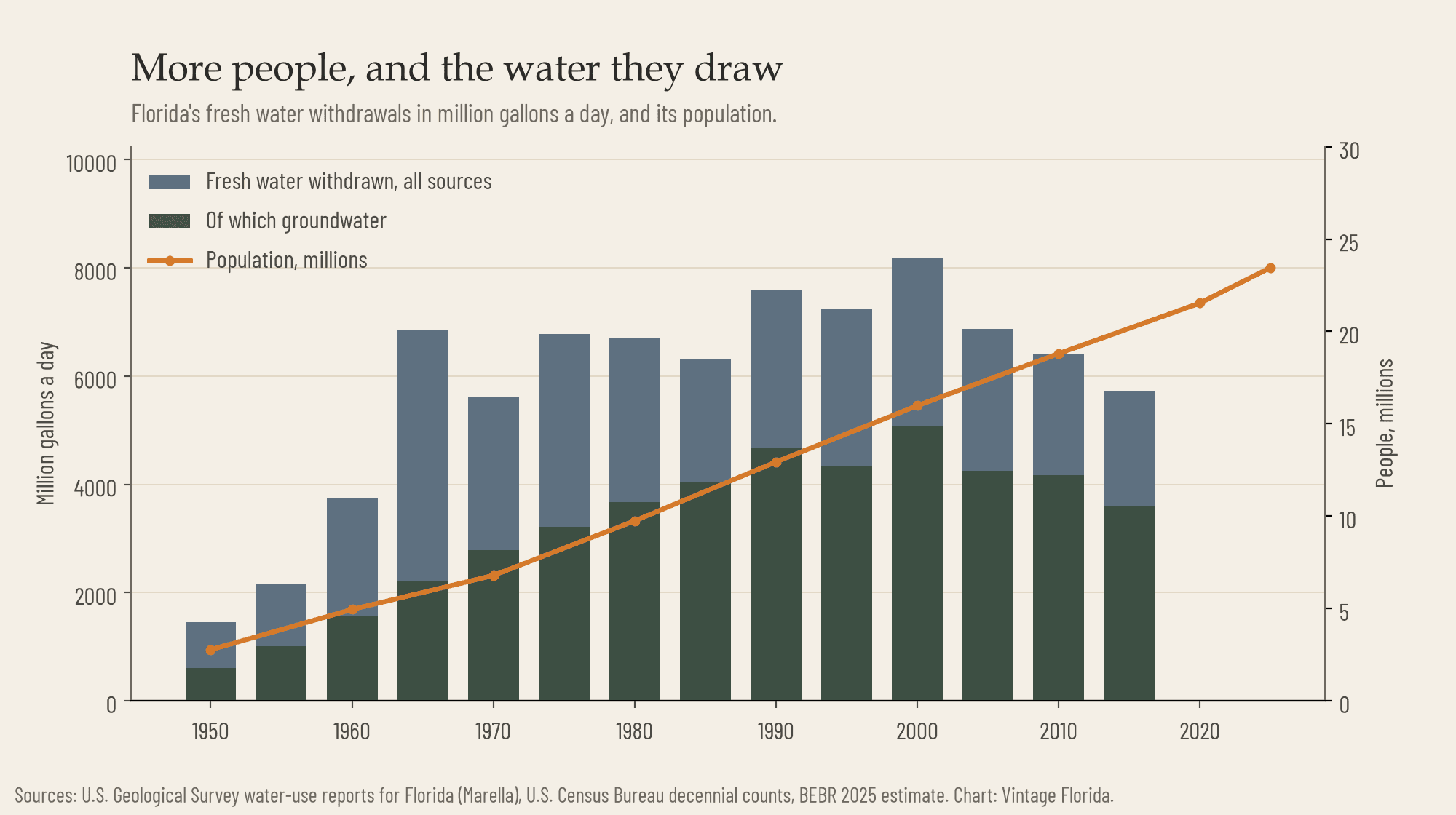
Something interesting shows up in that chart. Freshwater withdrawals kept rising until about 2000, when they reached roughly 8,200 million gallons a day, and then they fell. By 2015 the state was pulling about 5,700 million gallons a day for nearly four million more people. Part of that is conservation, part of it is reclaimed wastewater doing work that fresh water used to do, part of it is a change in accounting, and part of it is that the 2000 figure was a drought year with heavy irrigation. It is real progress, and it is also not the whole story, because the aquifer does not respond to the state's total. It responds to where the wells are.
Where the wells were concentrated, the water table fell. The USGS atlas records pressure in the Upper Floridan dropping more than 30 feet across a five county area southeast of Tampa Bay by 1980, with regional declines of ten feet or more in three separate parts of the state and deep local cones of depression under Fernandina Beach and Fort Walton Beach. When the pressure falls at the coast, salt water moves in. The flowing wells stopped flowing. Kissengen Spring, a second magnitude spring near Bartow that had been a swimming hole for generations, stopped running in 1950 as phosphate and citrus pumping drew down the aquifer around it. It has not come back.
The Tampa Bay region became the case study. Through the 1970s and 1980s the utilities serving Tampa, St. Petersburg, and their suburbs drew nearly everything from wellfields in Hillsborough and Pasco counties, and the lakes and wetlands over those wellfields dried up. Lawsuits between the counties ran through the 1990s in what the papers called the water wars. They ended with the creation of a regional utility, Tampa Bay Water, in 1998, a legal cap on wellfield pumping, and a commitment to find water somewhere other than the ground.
The clearest demonstration of what pumping does came in January 2010. A hard freeze settled over central Florida for eleven days, and strawberry and citrus growers around Plant City did what they have always done to protect a crop from frost. They ran their irrigation, coating the plants in ice that holds them at 32 degrees. The Southwest Florida Water Management District later estimated they were pumping about a billion gallons a night. The aquifer under the fields dropped as much as 60 feet. More than 140 sinkholes opened, roughly 750 domestic wells went dry, and the district put the damage at about $8 million. It was one of the largest sinkhole events ever recorded in the state, and it was made by people, in less than two weeks, with a known technique.
The Springs Now
The springs are where the aquifer shows its condition, and the USGS has been measuring the biggest of them for a long time. Silver Springs has a continuous gauge record back to 1933. We pulled the annual figures and averaged them by decade.
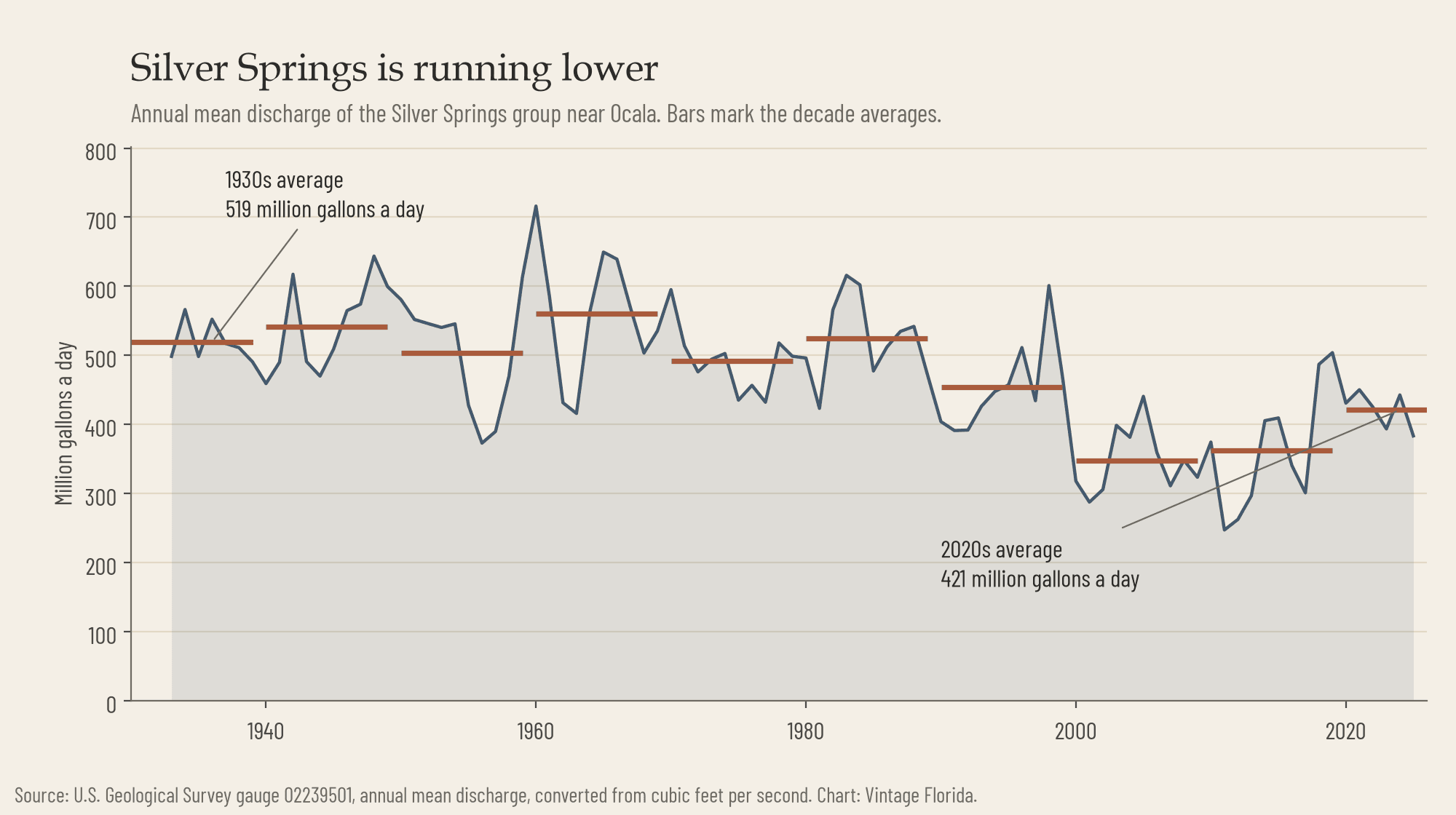
In the 1930s Silver Springs discharged an average of about 519 million gallons a day. In the 1960s it was 561 million. In the 2000s it was 348 million, the lowest decade in the record, and 2011 was the lowest single year. The 2020s have been wetter and the average has come back to about 421 million, still a fifth below where the record starts. The St. Johns River Water Management District, which regulates the spring, puts the long term decline at about 32 percent.
How much of that is pumping is the argument at the center of Florida springs policy. The district's own analysis, done for the minimum flow rule it adopted in 2017, attributes 13.3 percentage points of the decline to lower rainfall, 15.5 points to changes in the vegetation and the channel of the river, which the district says now holds the water back and raises the level at the vent, and only 3.5 points to groundwater withdrawals. Independent scientists, led by the Florida Springs Institute, argue the district has underweighted pumping and overweighted a vegetation effect that is itself partly a consequence of lower flow and higher nitrate. Both sides agree on the raw measurement. They disagree on what it means for how much more can be pumped.
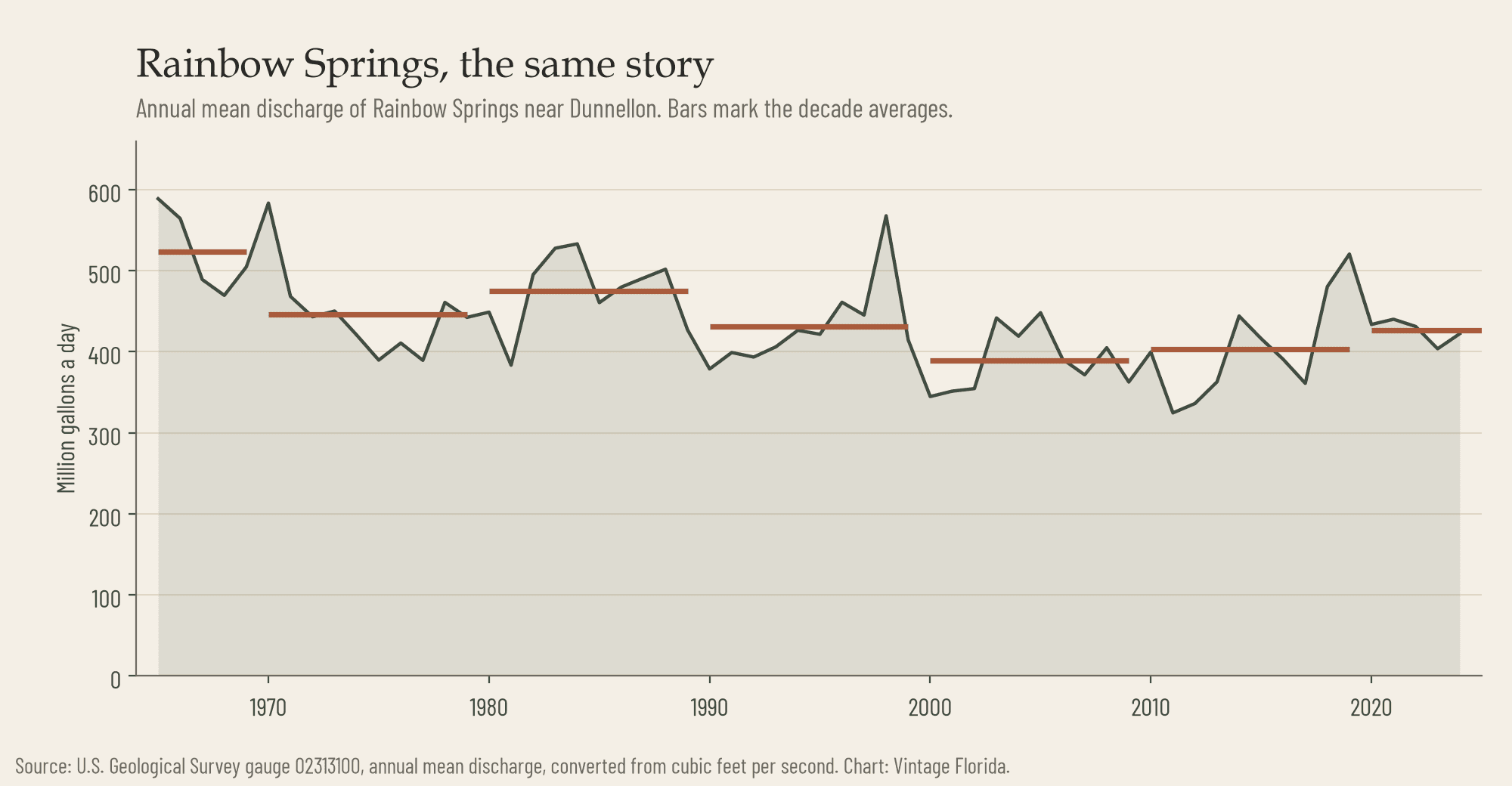
The pattern repeats. Rainbow Springs averaged about 523 million gallons a day in the 1960s and 389 million in the 2000s. On the Suwannee side of the state, the Springs Institute reports measured flow reductions of 28 percent in the Santa Fe River springs and 21 percent at Ichetucknee. In the spring of 2026, after six months of drought, the upper Santa Fe stopped flowing above its sink for a stretch, and springs along it that normally run clear turned to still pools. White Sulphur Spring at White Springs, the spa town on the Suwannee that built a three story bathhouse around its boil in 1908, went dry for the first time in 1977 and stopped for good around 1990. The bathhouse is still there. It surrounds a hole.
Both sides agree on the raw measurement. They disagree on what it means for how much more can be pumped.
The Nitrate Problem
Flow is one half of the story. The other half is what is in the water, and the answer is nitrogen.
Nitrate is the form of nitrogen that moves easily through soil and rock. It comes from fertilizer, from manure, from septic tanks and wastewater, and it rides the recharge straight into the aquifer. It does not make the water look dirty. Spring water carrying ten times the natural nitrate is still clear when it leaves the vent. What it does is feed algae. Given nitrogen and sunlight, filamentous algae grows over the eelgrass and the limestone in thick brown and green mats, the eelgrass dies, the fish go with it, and the white bottom that made the glass bottom boat worth building disappears under a carpet.
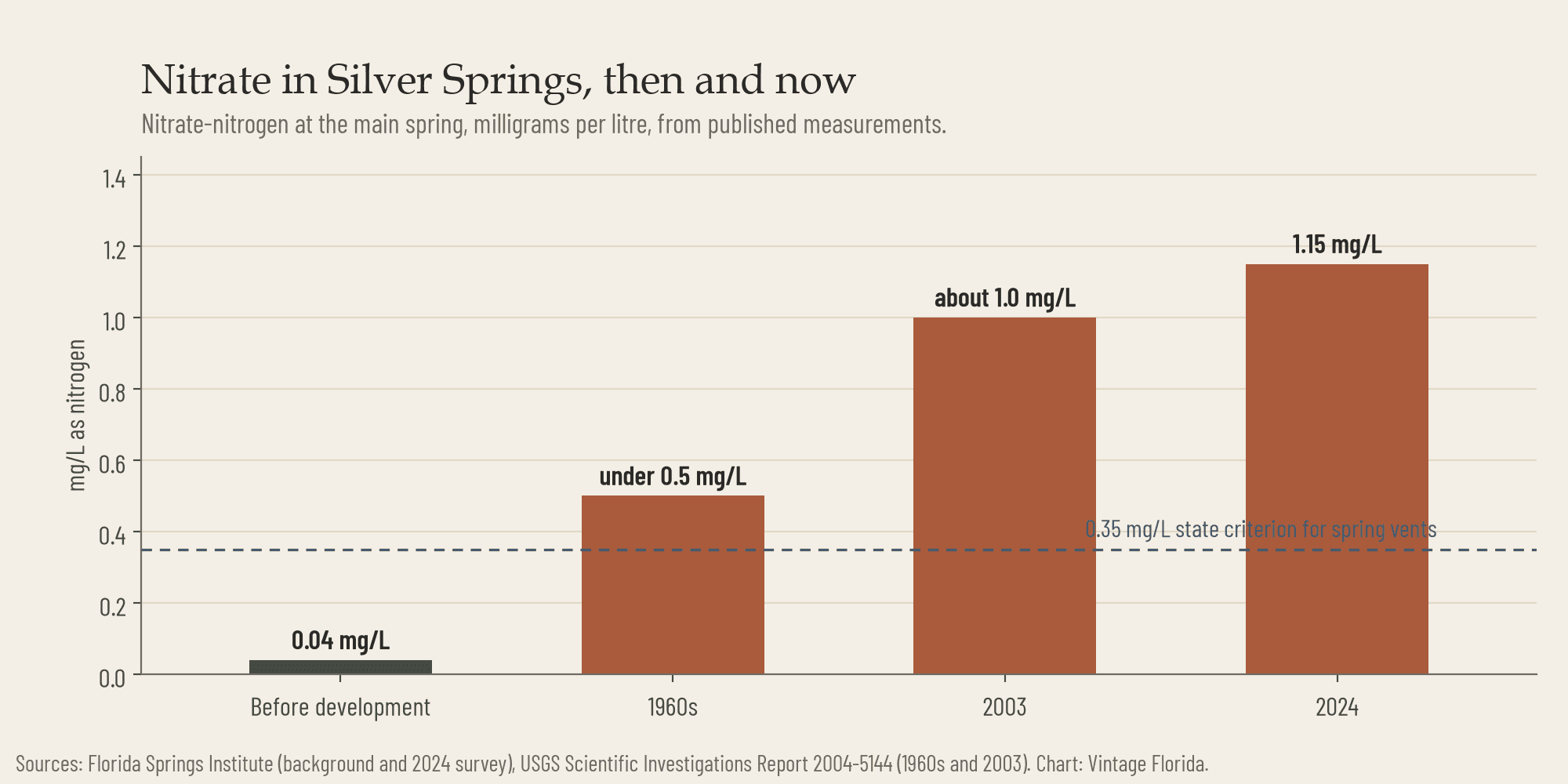
At Silver Springs the USGS measured nitrate below 0.5 milligrams per litre in the 1960s and about 1.0 by 2003. The Springs Institute's 2024 survey found 1.15. Florida's own water quality standard for spring vents, adopted by the state's Environmental Regulation Commission in December 2011, is 0.35 milligrams per litre as an annual average. Silver Springs has been over that line for the entire time the standard has existed, and it is not unusual. Of the 30 springs the legislature designated as Outstanding Florida Springs in 2016, the state has found 24 impaired for nitrate.
Where the nitrogen comes from is not a mystery. The Springs Institute's accounting, across the springsheds it has studied, puts about 70 percent of the load on agriculture, mostly fertilizer and livestock waste, about 17 percent on septic tanks and wastewater, and about 12 percent on fertilizer applied to lawns and landscaping. The proportions shift from one springshed to the next. In the Suwannee basin, dairy is a large share, with tens of thousands of cows on land that drains directly into the aquifer. Around Silver Springs and Wekiwa, closer to Orlando, septic tanks and lawns carry more of the weight. Florida has roughly 2.6 million septic systems, and a conventional tank removes very little nitrogen before the effluent reaches the sand.
How We Got Here
It is worth being honest that no single villain did this. The aquifer was drawn down and loaded with nitrogen by the ordinary business of a state growing from under three million people to more than 23 million in 75 years. Florida added something like 830 people a day between 2020 and 2025. Every one of them drinks, bathes, flushes, and, in most of the state, waters a lawn. The farms that feed them irrigate from the same rock. The rain that once soaked into sandhills now runs off roofs and parking lots into storm drains.
But the way the state governed water made it worse than it had to be. For most of the twentieth century Florida law treated groundwater as belonging to whoever owned the land above it, and the only limit on a well was the size of the pump. That changed with the Florida Water Resources Act, signed by Governor Reubin Askew in April 1972. The act made water a public resource, created the five water management districts that still run the system, required permits for large withdrawals, and told the districts to set minimum flows and levels for springs, rivers, and lakes below which further withdrawals would be significantly harmful.
The 1972 act was, on paper, one of the most advanced water laws in the country. The trouble was the last part. The districts were told to set minimum flows in 1972, and Silver Springs did not get one until 2017. Rainbow got its rule in 2017 too. For 45 years the largest springs in the state were permitted against no floor at all. When the floors finally came, they were set at the flows the springs already had, which by then were a third below the historical record, and the rules explicitly allow further reductions. The Silver Springs rule protects 94 percent of the flow the district calculated it should have, which is to say it allows the spring to be pumped down another six percent before the state is obliged to act. The district's own projections in 2017 said even that floor would not be met by 2025 without new water supplies.
Nitrogen went unregulated even longer. The state did not adopt a numeric nitrate limit for springs until 2011, and it did not tie that limit to any enforceable cleanup plan until the Florida Springs and Aquifer Protection Act of 2016. By then Silver Springs had been over the eventual limit for at least forty years.
What Is Being Done
The 2016 act is the framework the state is working under now. It named 30 Outstanding Florida Springs, required the Department of Environmental Protection to write a Basin Management Action Plan for every one of them that was impaired, and set a 20 year deadline for meeting the nitrate limit. The department adopted the 13 plans covering those springs in June 2018. Across them, the department calculated that nitrogen loading in the springsheds would need to come down by roughly two thirds. The act also drew priority focus areas around the springs where new septic tanks on lots under an acre are prohibited unless they use nitrogen reducing technology, and it required wastewater plants in those areas to meet a stricter nitrogen limit.
The same year, the Legacy Florida law dedicated a share of the state's documentary stamp revenue to springs restoration, the lesser of 7.6 percent or $50 million a year, which has funded septic to sewer conversions, land purchases in springsheds, and agricultural projects. The money is real and the projects are real. They are also small against the scale of the problem. Converting a single subdivision from septic to sewer runs into the tens of millions of dollars, and there are hundreds of thousands of tanks inside the priority areas.
On the supply side, the most consequential work is happening in the middle of the state. The three water management districts that meet around Orlando, together with the department and the utilities, formed the Central Florida Water Initiative to plan for a five county region that has effectively reached the limit of what the Upper Floridan can give. The plan they approved in November 2025 projects water demand in the region rising from about 639 million gallons a day in 2020 to about 906 million by 2045. Traditional groundwater can meet only part of that, and the plan identifies a shortfall of about 96 million gallons a day that has to come from somewhere else. It lists 140 projects to fill it: reclaimed water, surface water from the St. Johns, brackish water from the Lower Floridan treated by reverse osmosis, and conservation.
Reclaimed water is the quiet success. Florida reused about 958 million gallons a day of treated wastewater in 2024, according to the department, for irrigation, industry, and aquifer recharge, and the capacity to do so has more than doubled since 2000. Every gallon of reclaimed water on a golf course or a median is a gallon that did not come out of a well. Tampa Bay Water, the utility born out of the water wars, has run the largest seawater desalination plant in North America since 2007, rated at 25 million gallons a day, alongside a 15.5 billion gallon reservoir that stores river water from the wet season. The region's wellfield pumping is a fraction of what it was in 1998, and some of the lakes over the old wellfields have water in them again.
What Needs to Happen
Nobody who studies the aquifer thinks it is going to run dry. It holds an enormous amount of water, and in the northern part of the state it refills every summer. The question is whether Florida can keep the springs, which means keeping enough pressure in the rock to push water out of them and keeping enough nitrogen out of the rock that what comes out is clean. Here is what the scientists, the districts, and the department have said it would take, in their own documents.
- Set minimum flows that mean something, and enforce them. The Springs Institute and other critics point out that the 2016 act told the department to adopt a rule defining what harm to a spring looks like, and that rule has still not been adopted. Flow limits pegged to already diminished springs, with allowances for further decline, do not restore anything. They ratify the loss.
- Get the nitrogen out at the source. The basin plans call for cutting nitrogen loading by about two thirds. That cannot be done with voluntary agricultural best management practices alone, which is most of what the plans currently rely on. It means verified reductions in fertilizer and manure on farms in the springsheds, funded and measured, and it means sewer or advanced treatment for the septic tanks closest to the springs.
- Stop putting new demand on the Upper Floridan. The Central Florida Water Initiative has already concluded that its region is at the limit. The same logic applies to the Suwannee basin, the Santa Fe, and the springs coast. New growth has to be served by reclaimed water, the Lower Floridan, surface water, or conservation, and permitted that way.
- Use less per person. Public supply use per person has been falling for two decades, but in much of the state half of residential water still goes on lawns. Irrigation rules, rate structures that charge more for heavy use, and Florida friendly landscaping do more for the aquifer per dollar than any plant that can be built.
- Pay for it at the scale of the problem. Fifty million dollars a year is a rounding error against a state budget of well over $100 billion. Septic conversion alone in the priority areas is a multi billion dollar job. The fixes are engineering, not mystery, and engineering is a matter of money.
None of this is exotic. Tampa Bay has already done most of it, under a court order, and its aquifer is recovering. What the rest of the state has lacked is the same pressure that forced Tampa Bay's hand, because the harm to a spring accumulates slowly and shows up as a change in color rather than a dry tap.
The glass bottom boats still run at Silver Springs. The state bought the attraction in 2013 and made it a park, and on a clear morning you can still look down through the floor at the vent where the river starts. The bottom is greener than it was in the postcards, and the flow is a fifth lighter, and the fish are fewer. But the water still comes up, and it is still, against everything that has been done to it, very close to clear. That is the thing about an aquifer. It keeps offering you the chance to do better by it. The record since 1933 says how long that offer has been open.
Questions people ask
- Is Florida running out of fresh water?
- Not in the sense of the aquifer going dry. Florida's freshwater withdrawals peaked around 2000 at roughly 8,200 million gallons a day and had fallen to about 5,700 million a day by 2015 even as the population grew, through conservation, reclaimed water, a wetter run of years and a change in how brackish water is counted. The strain shows at the springs, which are the aquifer's visible face: many run lower and carry far more nitrate than they did a generation ago. The causes are known and so are the fixes; what is missing is mostly will, money and time.
- How deep is the Floridan aquifer?
- It varies with where you stand. The Floridan aquifer is a body of porous limestone under the whole peninsula, reaching north into Georgia, Alabama and South Carolina and covering about 100,000 square miles. In places it is about a hundred feet thick and in others more than 3,300 feet. The U.S. Geological Survey ranks it among the most productive aquifers in the world, and in 2015 it supplied close to two thirds of the groundwater Florida used.
- If the springs are polluted, why is the water still clear?
- Because nitrate does not make water look dirty. Nitrate is the form of nitrogen that moves easily through soil and rock, from fertilizer, manure, septic tanks and wastewater, and it rides the recharge straight into the aquifer. Spring water carrying ten times the natural nitrate is still clear when it leaves the vent. What the nitrate does is feed algae, which, given nitrogen and sunlight, grows over the bottom of the run and the plants that used to live there.