
news · 9 min read
Why Florida's Springs Are Losing Flow
Poe Springs stopped this summer. Rainbow and Ichetucknee are running below any full year in their records. What the state's own gauges and water districts say about where the water went.
By The Editors ·
Poe Springs sits on the south bank of the Santa Fe River a few miles west of High Springs, in a county park with a swimming area and a boat ramp. It is not one of the big springs. Across measurements from 1917 to 2007 its median flow was 50 cubic feet per second, about 32 million gallons a day, and the Suwannee River Water Management District, reviewing that record in 2013, found no trend in it over time. In 2016 the Legislature named it, by name, one of the Outstanding Florida Springs.
The week of July 16 this year Alachua County closed the swimming area after its tests found excess algae, falling clarity and a low aquifer. Stacie Greco, the county's water resources manager, told a Gainesville television station that the rain had been enough to keep lawns alive but not enough to recharge the aquifer. At the end of July the Florida Springs Institute, a research and advocacy group, reported that flow at Poe had been near zero for a month. By the middle of August it said the spring had stopped. Over Labor Day weekend the county closed the whole park for low water, and the president of Our Santa Fe River said the upper river had stopped going into the sink at O'Leno altogether, so that the stretch above Poe was barely moving.
None of this is quite new. Flow at Poe was essentially zero in May 2012, another drought year, and the Springs Institute calculates that the spring has averaged about 13 million gallons a day over the past two decades against 47 million in the years from 1917 to 1972, a reduction of 72 percent. That is the institute's arithmetic, not the district's, and the two are looking at different periods. But the drought that stopped Poe this summer is not the institute's opinion. It is in the gauges.
A dry year on a long decline
The Suwannee district's hydrologic report for April recorded a rainfall deficit of 20.22 inches over the preceding twelve months across the district, with parts of the Aucilla, Santa Fe and Suwannee basins more than 29 inches short. Most river gauges finished the month in the lowest tenth of their records. New daily minimum flow records for the period of record were set in April on the Suwannee at Ellaville and Branford, on the Santa Fe at Worthington Springs, on the Econfina at Perry and on the Withlacoochee at Pinetta. The district's long-term aquifer wells averaged around the twelfth percentile, and the well near Jasper set a record low for the month. By May 7 the federal Drought Monitor had most of the district in its highest category, exceptional drought. The district's governing board had already ordered water restrictions on April 14, effective April 22, limiting established lawns to one watering day a week. The St. Johns district had done the same on March 3 for eight northeast Florida counties and the parts of Alachua and Marion inside its boundary.
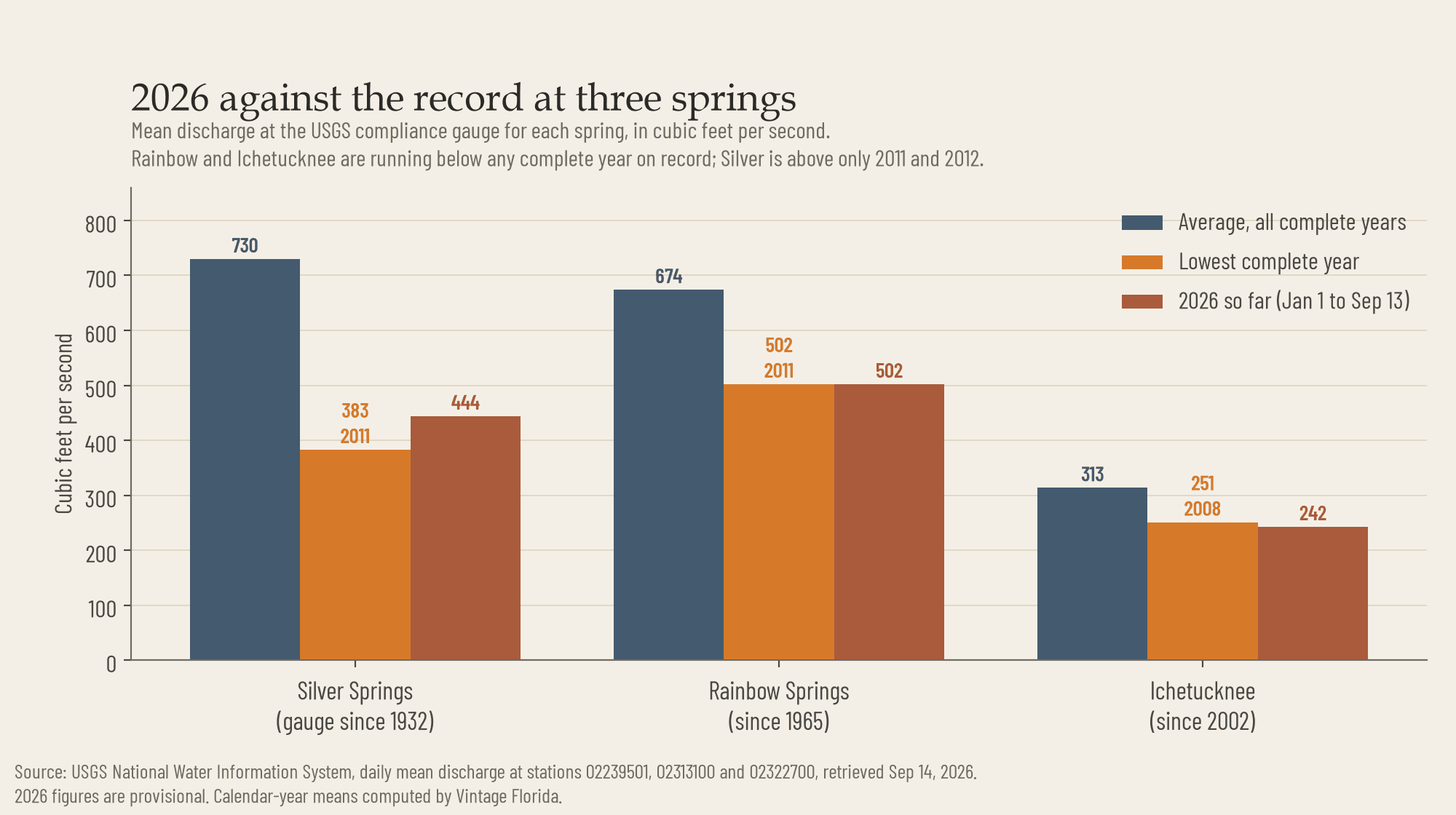
The USGS gauges on the spring runs show what that has done. Silver Springs, on the record of full years that runs back to 1933, has averaged 444 cubic feet per second so far this year against a long-term average of 730; only 2011 and 2012 were lower. Rainbow Springs, gauged since 1965, is at 502, level with its lowest full year, 2011. The Ichetucknee at the Highway 27 bridge, gauged since 2002, is at 242, below its lowest full year, 2008. The year is not over and the numbers are provisional, but a wet autumn would have to be very wet to move them much.
How much of it is pumping
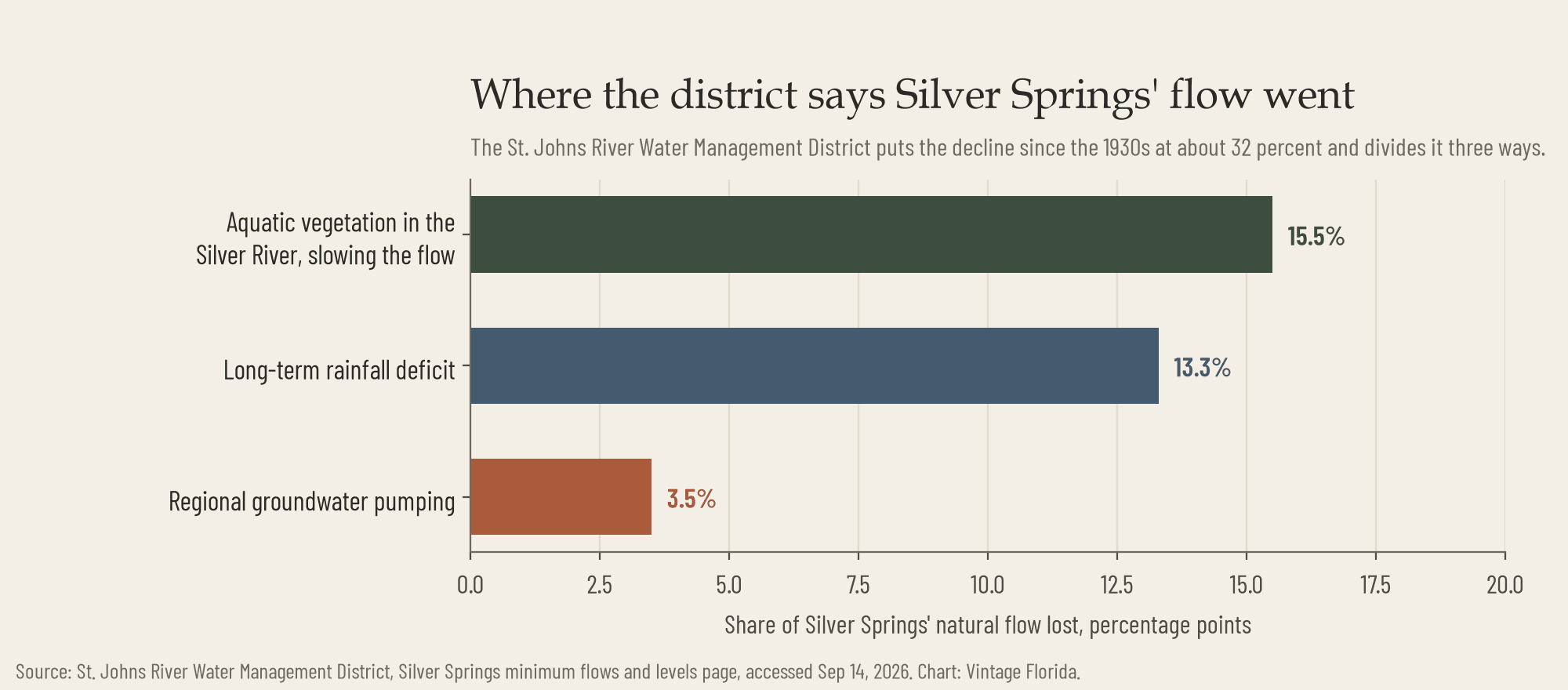
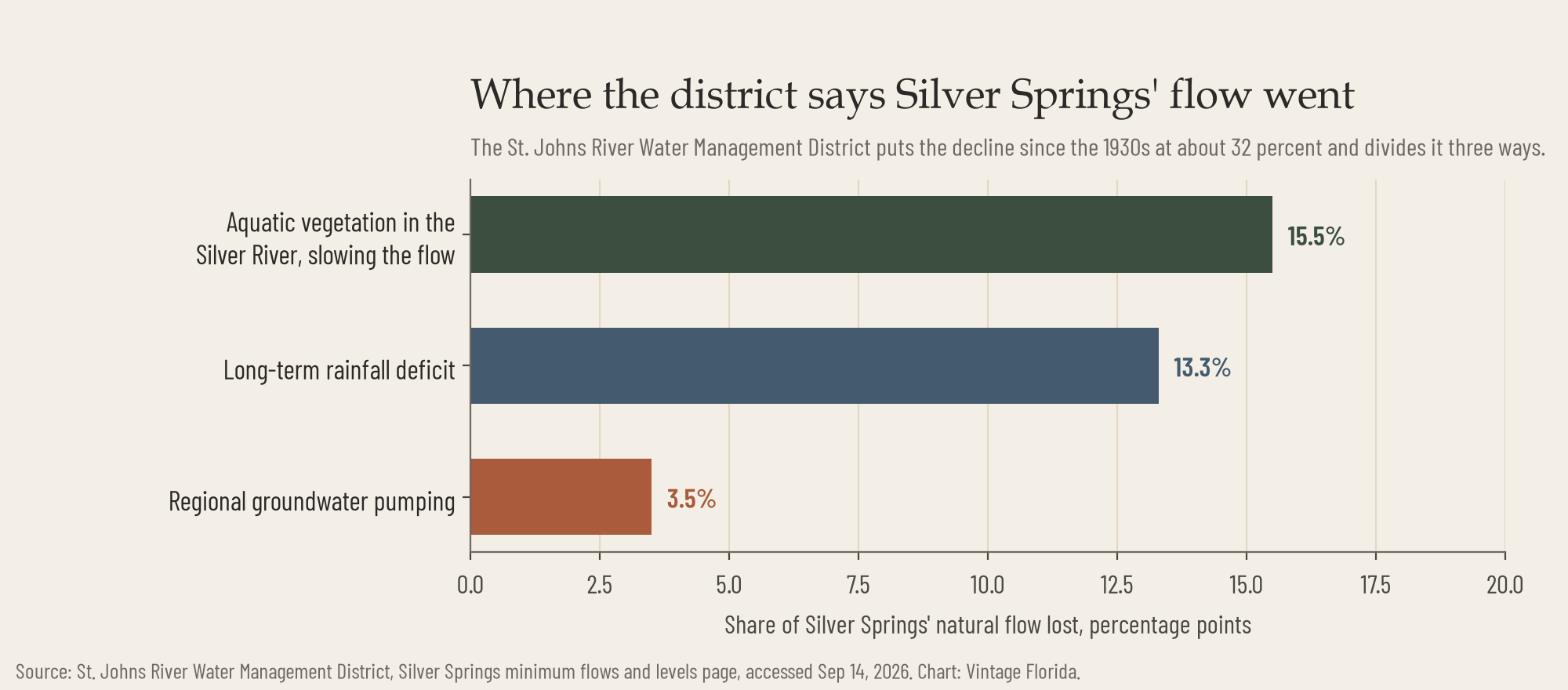
It depends which spring you ask about, and the districts have done the arithmetic. The St. Johns River Water Management District, which regulates Silver Springs, puts the spring's decline since the 1930s at about 32 percent from a historic mean of 820 cubic feet per second, and divides it three ways. A rainfall deficit the district puts at 112 inches between the 1970s and about 2000 accounts for about 13.3 percentage points. Submerged vegetation in the Silver River downstream of the boil, which slows the water and backs it up, accounts for about 15.5. Regional groundwater pumping accounts for about 3.5. The district's own minimum flow rule allows pumping to take 6 percent before the state must act.
At Rainbow Springs, thirty miles west, the Southwest Florida district reached a smaller number still. Its 2017 minimum flow report estimated groundwater withdrawals in the springshed at 22.1 million gallons a day in 2014, about 4.9 percent of the spring's average flow, and after allowing for the water that returns to the ground it put the effect on the spring at 2.2 percent at most, with its regional model saying closer to 1 percent. The district's report points to rainfall, which at Ocala, Inverness and Brooksville rose until the mid-1960s and has fallen since, in step with the multidecadal cycle in Atlantic sea temperatures. On the USGS record, Rainbow averaged 755 cubic feet per second in its first eleven years and 658 in the last ten, a drop of about 13 percent. The Florida Springs Council's figure of 25 percent since the 1960s is an advocacy number; it does not appear in the district's report.
The Ichetucknee is the other case. A USGS analysis published in 2011 estimated its flow had fallen 23 percent between 1900 and 2009, with the decline before 1980 consistent with pumping to the east that had diverted groundwater which once moved toward the river. That figure gets attached to Silver Springs in a lot of what is written online; it belongs to the Ichetucknee. The recovery strategy the two districts approved in November 2025 goes further. It does not divide the decline between rain and pumping. What it does is model the effect of 2014 to 2018 pumping on the gauge and find that effect large enough on its own to put the Highway 27 gauge under its minimum. Of that pumping impact, 77 percent comes from wells inside the two Florida districts and 22 percent from wells outside the state, most of them in south Georgia. On the Suwannee district's side the largest single use is agriculture, at 24 percent of the impact; on the St. Johns side it is public supply, at 23 percent, the utilities from Gainesville to Jacksonville whose wells reach the same aquifer. Statewide, Florida pumped about 3,600 million gallons of groundwater a day in 2015, the most recent year in the USGS's statewide series, 63 percent of all the fresh water the state withdrew.
What the rules allow
Florida's water districts are required to set a minimum flow for each of these springs, the level below which pumping would do significant harm, and to adopt a recovery strategy when a spring is under it or a prevention strategy when it is projected to fall under it within twenty years. Silver Springs got its rule in 2017. The district's page says all three of its minimums are being met, projected in 2017 that they would not be by 2025, and describes a prevention strategy: a treatment wetland using reclaimed wastewater, stormwater capture to recharge the aquifer, and new supply from the deeper Lower Floridan. Rainbow's rule, also from 2017, sets its minimum at 649 cubic feet per second, 5 percent below the withdrawal-adjusted average, and the district found no recovery or prevention strategy was needed.
The Ichetucknee is in recovery. The 2025 strategy puts the Highway 27 gauge 6.3 cubic feet per second below its minimum now and 13.2 below by 2045 if nothing changes, and the state rule that sets the minimum was amended effective July 1 of this year. The plan to close the gap leans on a 40 million gallon a day alternative water supply project for northeast Florida called Water First North Florida, still in planning, which the districts estimate would raise flow at the Ichetucknee gauge by up to 14 cubic feet per second, and on smaller recharge projects on Black Creek and the lower Suwannee. The target date for meeting the minimum is 2045.
Wakulla, south of Tallahassee, is the exception that shows what the gauges do and do not measure. Its minimum flow rule, from 2021, allows a 9.9 percent reduction from a baseline of 598 cubic feet per second, and the spring is comfortably above it; its gauged flow has averaged about 790 cubic feet per second since 2015 against about 700 in the decade before. What Wakulla has lost is clarity. The glass-bottom boats could not run regularly after 1992 and did not run at all in 2010, because the water coming up has too often been dark; the Springs Institute attributes that to tannic water from sinking streams in the Apalachicola National Forest now recharging the aquifer that feeds the spring. Kathleen Coates of the Northwest Florida district said in 2021 that the dark periods were not new, that they might be more frequent than they used to be, and that if they were, nobody clearly understood why.
What is being done
The Springs and Aquifer Protection Act of 2016 named thirty Outstanding Florida Springs and, within the areas that feed them, barred new conventional septic tanks on lots under an acre, new sewage plants that do not meet a nitrogen limit, and new farms that do not follow best management practices. Two years later the state adopted restoration plans for twenty-four of the springs, each with twenty years to meet its nitrate target. The targets are steep. Silver Springs needs a 79 percent cut in nitrate to reach the state's limit of 0.35 milligrams per liter; Rainbow needs 82 percent; the Ichetucknee springshed, under the Santa Fe plan adopted in June 2025, needs 49 percent. The settlement the Florida Springs Council reached with the Department of Environmental Protection this month covers seven Suwannee River springs and, according to the council, is to bar new conventional septic tanks around them by the end of 2030.
The money is set by statute at the lesser of 7.6 percent of a land trust fund or $50 million a year. The Legislature has gone above the floor three times, $100 million in the 2019 budget, $75 million in 2022 and $55 million in 2024, and has otherwise held at $50 million, including the two most recent budgets, which the Springs Council calls the minimum the law allows, next to roughly $800 million for the Everglades in the current one. The council's executive director, Ryan Smart, estimated in 2020 that replacing the septic tanks around four of the big springs alone would cost between $1.5 billion and $3 billion.
Poe will flow again when the rain comes back, as it did after 2012. Kissengen Spring, near Bartow, has not, apart from six weeks after the hurricanes of 2004. It gave about 20 million gallons a day when the U.S. Geological Survey first measured it in 1898, declined after 1936 as pumping in southwest Polk County climbed toward 110 million gallons a day, about 70 percent of it for phosphate, and stopped in February 1950, the first large spring in the state to be pumped dry. The report on it, published the next year, was titled Cessation of Flow of Kissengen Spring. Seventy-six years later the gauges at Rainbow and the Ichetucknee are running lower for the year than in any full year on their records, and at one of the two the state's own model says pumping by itself is enough to hold the spring below the floor the state set for it.
Questions people ask
- Why are Florida's springs losing flow?
- Three things, in different shares at different springs. Less rain over the long run: the St. Johns River district attributes 13.3 percentage points of Silver Springs' roughly 32 percent decline to a rainfall deficit, and the Southwest district ties Rainbow's decline mainly to the rainfall cycle since the 1960s. Groundwater pumping, which the districts put at 3.5 points at Silver and about 1 to 2 percent at Rainbow, and which at the Ichetucknee is enough on its own to hold the Highway 27 gauge 6.3 cubic feet per second below its minimum flow. And, at Silver, aquatic vegetation in the river that slows the water. On top of the long decline, 2026 is a drought year, with the Suwannee district recording a 20-inch rainfall deficit by April.
- Which Florida springs have stopped flowing?
- Kissengen Spring near Bartow was the first. It gave about 20 million gallons a day when the USGS first measured it in 1898 and stopped flowing continuously in February 1950, after groundwater pumping in southwest Polk County, most of it for phosphate, lowered the aquifer around it. Poe Springs on the Santa Fe River went to near zero in May 2012 and again in the summer of 2026, when Alachua County closed its swimming area and the Florida Springs Institute reported that flow had ceased. Poe's flow returns when the aquifer recovers. Kissengen's did not, apart from six weeks after the 2004 hurricanes.
- Is groundwater pumping the main cause?
- It depends on the spring. At Silver Springs the district's analysis assigns pumping 3.5 percentage points of a 32 percent decline. At Rainbow the district's model puts the effect of 2014 pumping at about 1 percent. At the Ichetucknee the 2025 recovery strategy finds that pumping alone has pushed the Highway 27 gauge 6.3 cubic feet per second below its minimum. Of that pumping impact, the districts' model puts 77 percent on wells inside the two Florida districts and 22 percent on wells outside the state, most of them in south Georgia.
- What is a minimum flow?
- A limit set by a water management district, or by the Department of Environmental Protection where a springshed crosses district lines, on how far a spring's flow may be reduced by pumping before the state must act. Silver Springs' rule, adopted in 2017, allows a 6 percent reduction. Rainbow's allows 5 percent. Wakulla's, from 2021, allows 9.9 percent. When a spring is below its minimum, or is projected to fall below it within twenty years, the district must adopt a recovery or prevention strategy. The Ichetucknee at Highway 27 is in recovery, 6.3 cubic feet per second short of its minimum.